
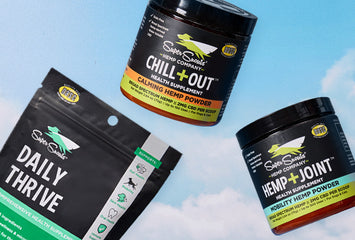

Good news first: the Wirehaired Pointing Griffon is one of the healthier sporting breeds we cover, so its supplement plan is short — cartilage nutrition for documented hip and elbow screening concerns, dependable gut tools for a dog that forages marshes for a living, and immune-supporting basics for a hard-working water coat. Short doesn't mean skippable; it means every item earns its place.
The supreme gundog nobody's heard of
Eduard Korthals, a Dutch breeder working in 19th-century Germany and France, set out to design the ideal walking hunter's companion — and Griffon devotees will tell you he succeeded. The Griff stands 20–24 inches, weighs 35–70 pounds, and wears a harsh steel-gray-and-brown wire coat with an undercoat that insulates like down. The face, all eyebrows and mustache, telegraphs the breed's character: earnest, comic, eager to be in on whatever you're doing.
Griffs point, retrieve on land and water, and then — unusual for a versatile hunter — settle into the house like they were bred for the hearth too. The AKC gives a 12–15 year life expectancy and lists hip, elbow, eye, and cardiac evaluations as recommended screens. Note what's largely absent from the breed's file: the long allergy and endocrine rap sheets many sporting breeds carry. We'll respect that by not inventing needs.
Hips and elbows: the one orthopedic priority
The reason the parent club screens both hips and elbows is that dysplasia in either joint is documented in Griffs, even at modest rates. A medium-size dog that leaps into duck boats, breaks through cattail ice, and hikes double-digit miles gives imperfect joints plenty of chances to complain in middle age — typically as post-exercise stiffness, a shortened front stride (elbows), or reluctance to jump (hips).
Our joint philosophy fits this breed especially well: concentrate on one whole-food ingredient rather than diluted multi-ingredient formulas. New Zealand green-lipped mussel naturally bundles glucosamine, chondroitin, and a distinctive omega-3 set including ETA — the working parts of most joint products, grown in one shellfish. That's the entire formula of Joint Power. Start after your veterinarian confirms growth is finished, and let them baseline the joints with a hands-on exam first — a thirty-second palpation now makes every future comparison meaningful.
Keep the frame lean, too. Griffs are moderate dogs by design, and the healthiest thing an owner controls is the number on the scale; extra weight is a tax every joint pays daily.
The forager's gut: what a marsh dog's stomach encounters
A Griffon's workday reads like a GI stress test — pond water in three flavors, mystery items mouthed in the reeds, adrenaline, truck rides. Even the homebody Griff inherits the forager's enthusiasm for eating first and evaluating later. Most of what follows is 24 hours of unhappy stomach, and this is where a prepared shelf shines.
For plain loose stool, soluble fiber is the workhorse: pumpkin and apple pectin absorb excess water in the colon and restore form, which is the entire job description of Firm Up!, our best-selling product for a reason. For the gassier, groanier presentations — the dog whose abdomen audibly renegotiates after a rich weekend — a probiotic-and-botanical blend like G.I. Balance addresses the ecosystem rather than just the output. Draw the veterinary line clearly: diarrhea past two days, any blood, repeated vomiting, fever-lethargy, or a puppy or senior going downhill fast — those go to your clinic, because pond water occasionally delivers giardia and worse, and Cornell's canine health resources will tell you the same.
One structural note: some Griffs run deep enough in the chest that bloat-smart habits are cheap insurance — split meals, slower eating, calm after dinner. The breed isn't a headline GDV risk like the giants, but the habits cost nothing.
Immune support for the dog that works wet
Cold water, dense cover, and long aerobic days ask steady questions of a working Griff's immune system, and the wiry coat hides early skin trouble from view. Our everyday answer is beta-glucans — immune-active polysaccharides concentrated in mushrooms like turkey tail, whose research literature (searchable on PubMed) spans decades of immunology. We offer that single species straight in Turkey Tail, which suits the Griff plan's minimalist spirit: one documented need, one clean ingredient. Position it honestly — nutritional support for a normal immune system, not protection against pathogens; vaccines, parasite prevention, and post-swim ear checks with your veterinarian do that heavy lifting.
Grooming is the other half of skin health here: hand-stripping or regular raking keeps the wire coat functional, and beard hygiene after water work prevents the funk that gets misread as skin disease.
What we'd deliberately leave out
Calming aids — the Griff is people-oriented and biddable, and routine anxiety isn't a breed pattern; genuine behavior problems merit a trainer or veterinary behaviorist, not a chew. Dedicated allergy formulas — not a documented breed emphasis; individual itchy dogs need diagnosis first. Multivitamins on top of complete commercial diets — redundant at best. A shorter stack, dosed consistently, beats a crowded one abandoned by March.
The Griffon plan, condensed
- Daily from maturity: green-lipped mussel for hips and elbows.
- On the shelf, always: pumpkin fiber and a probiotic blend — the forager's cleanup crew.
- Daily for working or waterlogged dogs: turkey tail beta-glucans.
- Habits: lean weight, split meals, post-swim ear checks, annual exams with joint palpation.
Bring the list to your vet and let them personalize it — age, workload, and history all move the pieces.
Wirehaired Pointing Griffon FAQ
Are Griffs really as healthy as breeders claim?
The breed benefits from a small, health-conscious founding community and active screening culture, so its documented issue list is genuinely short. Individual dogs still vary — buy from breeders who publish hip, elbow, eye, and cardiac results, and keep your own dog's annual exams current.
My Griff swims constantly. Anything special to supplement?
Swimming itself is superb low-impact joint work — no extra products required for the activity. The practical risks are ears and whatever the water contained, so dry ears after swims and involve your veterinarian at the first head-shake or foul odor.
When does a Griffon count as a senior for supplement purposes?
Around age eight to nine for most, though hard-hunting dogs may earn earlier senior workups. That's when annual bloodwork, joint re-checks, and a conversation about adjusting servings belong on the calendar with your veterinary team.
Can I use the same gut products for my Griff puppy?
Puppy diarrhea plays by different, faster rules — dehydration risk is real and parasites are common. Call your vet first for any puppy GI episode; fiber support may be part of their plan, but it shouldn't be yours alone.
Final word
Korthals built the Griffon to be low-drama, and the supplement plan should honor that: feed the joints that do the leaping, stock the shelf for the forager's inevitable adventures, support the immune system that works wet, and skip the rest. Your veterinarian keeps the plan honest — see them yearly, and this mustachioed overachiever should hunt, hike, and hog the couch deep into its teens.
This guide is educational, not medical advice. Your veterinarian can help you decide which supplements make sense for your Griffon's age and lifestyle.