

Because a Sheepadoodle is an Old English Sheepdog crossed with a Poodle, its supplement plan should be built from both parent breeds' documented patterns: hip dysplasia risk on both sides of the pedigree, bloat-capable body types, and a high-maintenance coat that reflects gut and immune health. Which traits your individual dog inherits is a genetic coin flip — that variability is the defining fact of every designer mix, and it's why we frame this guide as probabilities, not certainties.
What's actually in a Sheepadoodle
Most Sheepadoodles pair an Old English Sheepdog with a Standard Poodle, producing dogs from 45 to 80+ pounds (mini versions using smaller Poodles exist but are less common). Both parents are smart, athletic working breeds — OES as drover, Poodle as water retriever — so the cross tends toward playful, people-oriented, sometimes herding-nippy dogs with real exercise requirements. Coats range from loose waves to tight curls, usually in that signature black-and-white patchwork, and almost always demand serious brushing commitment. Lifespan estimates typically run 12–15 years.
No mix inherits a guaranteed health chart. What we can do is read the parent breeds' documentation — the OFA tracks orthopedic statistics for both — and prepare for the likelier scenarios.
Hips first: the risk both parents share
Hip dysplasia is documented in Old English Sheepdogs at notably high rates and in Standard Poodles as well, making structural health the Sheepadoodle's most defensible supplement priority. If you're buying a puppy, ask for hip scores on both parents; if you're already living with your dog, the plan is the same regardless of paperwork.
Lean body condition is the intervention with the strongest evidence behind it — landmark lifetime studies in Labradors showed leaner dogs developed less joint disease over their lives, and the principle generalizes. Your veterinarian can set a target weight and check progress at each visit; for a fluffy dog whose coat hides its outline, hands-on rib checks beat eyeballing every time.
On the nutrition side, we like whole-source simplicity: New Zealand green-lipped mussel provides omega-3s (including the rare ETA), chondroitin, and glycosaminoglycans in one traceable ingredient. That's the complete formula of Joint Power. Large, fast-growing doodle puppies shouldn't start supplements until your vet confirms growth-plate timing — raise it at the 12-month visit.
A deep chest means bloat literacy
Standard Poodles are a documented gastric dilatation-volvulus risk breed, and larger Sheepadoodles frequently inherit that deep-chested silhouette. Every owner of a 50-plus-pound doodle should be able to recite the emergency signs from memory: hard swollen belly, dry heaving that produces nothing, sudden frantic discomfort. That combination means an emergency clinic immediately — Cornell's GDV explainer is required reading.
Daily prevention is behavioral, and we'll say clearly that no product on the market — ours included — prevents GDV. Feed multiple smaller meals, slow down speed-eaters, and buffer meals from vigorous play. What supplements can address is routine digestive comfort: doodles are famous for gassy, gurgly stomachs (many inherit the Poodle's sensitive gut), and our G.I. Balance targets everyday gas and stomach upset with probiotics plus digestive botanicals. Separate lanes: comfort support versus emergency awareness. Keep both straight.
The coat is a gut report card
That plush Sheepadoodle fleece grows fast, mats faster, and its quality tracks internal health surprisingly closely. Dull, brittle, or flaky often points inward — to diet, gut absorption, or immune irritation — before it points to shampoo. With roughly two-thirds of immune activity residing in gut-associated tissue, microbiome stability and skin condition are neighbors, not strangers.
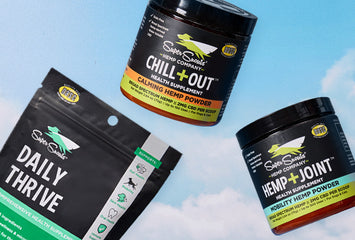
Our inside-out approach: a complete diet as the foundation, steady probiotic support, and beta-glucan-rich functional mushrooms as a whole-food immune input. Super Shrooms bundles seven organic species for exactly this job. If your doodle scratches persistently, chews paws, or develops recurring ear infections — patterns Poodle-cross owners know well — have your veterinarian investigate allergies properly instead of stacking supplements on an undiagnosed problem.
Building the routine, doodle edition
- Feeding: 2–3 measured meals, slow-feeder if food vanishes in under two minutes, 7–10 day diet transitions.
- Joints: green-lipped mussel daily from vet-confirmed skeletal maturity; weight checks with hands, not eyes.
- Gut: G.I. Balance for the chronically gassy; Firm Up! on standby for loose-stool days after dog park buffets.
- Coat: brushing several times weekly, mushroom blend for immune-side support, vet workup for persistent itch.
- Safety net: every addition gets a veterinary sign-off, especially for puppies still growing.
Sheepadoodle FAQ
Are Sheepadoodles prone to hip dysplasia?
Both parent breeds carry documented risk, so yes — treat it as a probability worth planning for. Parent health testing lowers the odds; lean weight and vet-monitored joint support manage whatever genetics dealt. A young dog that bunny-hops or tires unusually fast needs an orthopedic exam.
Why is my Sheepadoodle so gassy?
Poodle-line digestive sensitivity plus enthusiastic eating is the usual recipe. Slower meals, a consistent diet, and daily probiotic-botanical support typically shrink the problem. Gas alongside a distended, painful abdomen is an emergency — different situation entirely, act immediately.
Do Sheepadoodles have allergies?
Some inherit atopic tendencies; recurring ear infections and paw-chewing are the tells. Internal support helps normal immune function, but identifying the actual trigger — food, fleas, environment — is veterinary detective work worth doing once and properly.
When should a Sheepadoodle start joint supplements?
After growth plates close, which your veterinarian can confirm — typically around 12–18 months for larger doodles. Starting earlier isn't proven to help and skips a needed vet conversation about your puppy's development.
Last word
A Sheepadoodle hands you the OES's structure questions, the Poodle's stomach and chest, and a coat that files daily reports on both. Play the probabilities: guard the hips with lean weight and green-lipped mussel, respect the bloat rules at every meal, feed the gut that feeds the coat — and let your veterinarian referee which parent breed your particular dog actually takes after.