

Pet supplement aisles are stacked with formulas that treat every dog the same. A Weimaraner isn't every dog. The Weimaraner was developed in 19th-century Germany to hunt big game — originally bear, wolf, and boar, later birds. The silver-gray coat gave rise to the breed's nickname, the Gray Ghost. The breed came from a specific working context, and that context still explains most of the health considerations on the table today.
Cut the noise and pet supplement science narrows down quickly: a short list of ingredients with peer-reviewed support, dosed appropriately to the individual dog. For a Weimaraner, that short list is what this guide covers, category by category.
Why Weimaraners need a tailored supplement plan
Large breeds like the Weimaraner, typically 55-90 lbs at adulthood, carry elevated lifetime risk of joint wear, certain digestive issues, and chronic inflammation compared to smaller dogs. Longevity drops a step for every 20 pounds of body weight in dogs — not a reason to panic, a reason to plan. On top of the physical profile, the Weimaraner is a driven hunting breed with high exercise requirements — a disposition that shapes how stress, exercise load, and recovery all play out day to day.
This context isn't reason to panic. Weimaraners commonly reach a 10-13 years lifespan in good shape when their care is considered. The supplements worth paying for are the ones that track to the breed's actual risks — nothing else reliably earns its place.
When you strip supplement choices for a Weimaraner down to what's actually supported by breed data, four categories remain: joint and mobility, digestive health, skin and coat, and calming support.
Joint and mobility: glucosamine, chondroitin, and green-lipped mussel
Joint health matters for Weimaraners, even if the breed isn't in the highest risk tier. Hip dysplasia and cruciate injuries are both tracked; the breed's high drive often results in overuse injuries. The most common mistake owners make is waiting for visible stiffness before starting support — by then, the underlying wear has usually been developing for years.
Canine joint science lands on three ingredients with the strongest track record: glucosamine, chondroitin sulfate, and MSM. Glucosamine is a building block of cartilage synthesis. Chondroitin sulfate helps cartilage retain water, which is what lets it cushion joints. MSM (methylsulfonylmethane) delivers sulfur that supports connective-tissue integrity. Skip one, and the formula is incomplete.
For a one-ingredient joint intervention, green-lipped mussel carries the strongest case. It supplies glucosamine and chondroitin naturally and contributes omega-3 fatty acids — including the rare ETA — that support a balanced inflammatory response. Peer-reviewed studies running 8 to 12 weeks have demonstrated real improvements in joint comfort in supplemented dogs. For a Weimaraner, that's multiple mechanisms engaged from a single input.
Joint Power keeps the formula short on purpose: just New Zealand green-lipped mussel, cold-processed and lipid-stabilized to preserve the active omegas. No synthetic glucosamine, no fillers. It sprinkles over food — practical for a 90 lbs dog who'd rather skip pills.
For a Weimaraner, two to four years old is a reasonable default for starting joint support, earlier for dogs with a family history of dysplasia or heavy work demands.
Digestive health: stool consistency, gas, and acid reflux are three different problems
Deep-chested breeds like the Weimaraner carry an elevated lifetime risk of bloat — a twisting of the stomach that is a true emergency. According to VCA Animal Hospitals, large, deep-chested dogs are among the most susceptible. No supplement prevents bloat. What supports a Weimaraner's digestive system is day-to-day stability: multiple smaller meals, no vigorous exercise around mealtime, and consistent stool quality so you notice changes fast.
The gut is the base layer of day-to-day wellness, and problems there propagate everywhere else. What gets labeled as 'digestive issues' is almost always three separate patterns: stool consistency that swings loose or firm, gas and bloating, and acid reflux. Matching the right ingredient profile to the right pattern is what makes a difference.
When stool consistency is the problem, dried pumpkin is the ingredient with the most real-world and clinical backing. It works in both directions: its soluble fiber slows loose transit, and its insoluble fiber bulks up dry stool. Firm Up! is built around that fact with a two-ingredient formula — dried pumpkin and dried apple — and doesn't try to stretch the label further.
Gas and bloating are a microbiome-and-motility question, not a fiber-bulk question. Prebiotic fibers feed beneficial microbes; carminative herbs ease the smooth-muscle tension that traps gas. G.I. Balance reflects that split: pumpkin, apple pectin, organic fennel seed, ginger, and organic agave inulin. Veterinary-recommended, and aimed squarely at the grumbly-stomach days a Weimaraner sometimes has.
For acid reflux and vomit prevention, ingredients change again. Goat milk acts as a gentle acid buffer and contributes bioavailable nutrition; pumpkin provides mucosal soothing. Pumpkin Latte is the combination, built as a low-effort daily option for Weimaraners who deal with morning bile, intermittent throwing up, or reflux patterns.
Skin and coat: omega-3s, quercetin, and functional mushrooms
Short-coated breeds like the Weimaraner still need skin support. The sleek, short coat is low-maintenance but offers little protection — the breed is prone to contact allergies.
The evidence base for canine skin health points at three ingredient families. First, EPA and DHA omega-3 fatty acids — they reinforce the skin barrier and soften the biochemical pathways behind itch. Second, quercetin — a plant flavonoid with research support for a normal histamine response, sometimes called 'nature's Benadryl.' Third, beta-glucans from functional mushrooms (reishi, turkey tail, chaga, shiitake, lion's mane, maitake, cordyceps) which modulate the overactive immune responses usually lumped into 'seasonal allergies.'
Super Shrooms is our seven-mushroom formulation — one inactive ingredient, nothing else. It sprinkles over food and does double work: skin support and wider immune modulation. That's the daily product we reach for with Weimaraners whose allergies peak in predictable seasons.
A skin supplement isn't the first intervention — it's the last layer. Rule out food allergies, environmental triggers, and fleas first, since those drive the majority of skin issues. Once the upstream stuff is handled, omega-3 fatty acids and mushroom-derived beta-glucans produce visible improvement in most dogs over a few weeks.
Calming: L-tryptophan, chamomile, and the GABA pathway
Weimaraners are social and high-energy, which sometimes masks stress. Weimaraners are among the breeds most commonly diagnosed with separation anxiety — the bond is intense and the work drive is high.
Unlike a sedative, a well-built calming supplement supports the pathways that produce calm rather than forcing drowsiness. L-tryptophan is the precursor amino acid for serotonin synthesis. L-theanine encourages alpha-wave brain activity associated with relaxed focus. Chamomile and passionflower carry traditional anxiety support and some canine data. Hemp-derived compounds are adding fresh research for situational stress specifically.
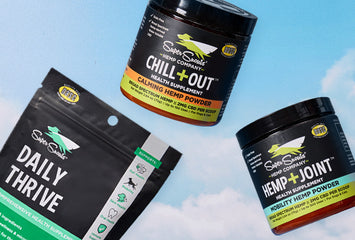
For trigger events you can plan around — fireworks, thunderstorms, vet visits, travel — Chill + Out is the product we formulate for the job. It's a chew that combines L-tryptophan, chamomile, passionflower, and broad-spectrum hemp (THC removed to non-detectable levels), dosed 30 to 60 minutes before the stressor. Hemp-free households get similar mileage from structured exercise, routine consistency, and desensitization work for Weimaraners.
Building a realistic routine
No one keeps up with a maximalist supplement routine for long. The realistic baseline for a healthy adult Weimaraner is three products: a daily joint supplement built on green-lipped mussel (effectively non-optional for most breeds as they age), a digestive product matched to the actual pattern (Firm Up! for stool consistency, G.I. Balance for gas, Pumpkin Latte for reflux), and a mushroom blend for skin and allergy support. Keep calming support as an as-needed tool for the stressors you can plan around: fireworks, travel, vet visits.
Important context: the list above is the Weimaraner's specific list. It's built around joint and mobility, digestive health, skin and coat, and calming support — the breed's documented risks — and intentionally doesn't reach further. A category the breed isn't flagged for doesn't need a daily product thrown at it, and adding one usually produces the worst of both worlds: more work, no improved outcome. If new issues emerge outside that scope later, a vet-guided addition makes sense then — not now.
Two things to get right. First, the dose. Every product here is weight-based, and underdosing is the single most common mistake — a Weimaraner at 55-90 lbs needs the specified amount for that weight, not a conservative pinch. Second, supplements layer on top of a solid foundation: quality diet, a healthy weight, appropriate exercise, routine vet care. They aren't a shortcut around any of that. Expect effects over four to eight weeks of consistent use, not overnight.
Done right, a Weimaraner's supplement plan isn't about stacking more. It's about matching real breed risks to ingredients with real research backing — and letting everything else fall away.