

There's no one-size-fits-all wellness routine, and the Standard Poodle is a clean example of why. The Standard Poodle was developed as a water retriever — the decorative clip started as functional grooming for swimming. The breed is highly trainable, athletic, and often underestimated because of the coat. Those working origins still show up in the dog on your couch — in build, metabolism, and temperament — and a supplement routine that ignores them misses the dog.
The pet supplement industry rewards complexity for its own sake. The reality for a Standard Poodle is simpler — a narrow set of ingredients with real research behind them, dosed to the dog. The section below walks through each category that matters.
Why Standard Poodles need a tailored supplement plan
Large breeds like the Standard Poodle, typically 40-70 lbs at adulthood, carry elevated lifetime risk of joint wear, certain digestive issues, and chronic inflammation compared to smaller dogs. Longevity drops a step for every 20 pounds of body weight in dogs — not a reason to panic, a reason to plan. On top of the physical profile, the Standard Poodle is a sporting breed disguised as a show breed — a disposition that shapes how stress, exercise load, and recovery all play out day to day.
Framed correctly, none of this is worrying information. The typical Standard Poodle has a 12-15 years lifespan and plenty of good years in them. The supplement choices that help are the ones aimed at what the breed is actually dealing with, not what the average dog might theoretically benefit from.
For a Standard Poodle, five categories cover most of where supplements actually earn their keep: joint and mobility, digestive health, skin and coat, calming support, and long-term immune support.
Joint and mobility: glucosamine, chondroitin, and green-lipped mussel
Joint health matters for Standard Poodles, even if the breed isn't in the highest risk tier. Hip dysplasia is a tracked issue, and Standards are prone to Addison's disease and sebaceous adenitis — systemic conditions worth knowing about. The most common mistake owners make is waiting for visible stiffness before starting support — by then, the underlying wear has usually been developing for years.
Three ingredients anchor the evidence base for canine joint care: glucosamine, chondroitin sulfate, and MSM (methylsulfonylmethane). Glucosamine contributes to the raw material of cartilage. Chondroitin sulfate supports cartilage's ability to resist wear and compression. MSM supplies the sulfur that connective tissue requires. Everything else a joint formula does is layered on top of these three.
For single-ingredient efficiency, green-lipped mussel is hard to beat. It's a concentrated source of glucosamine and chondroitin and carries an omega-3 profile — including ETA, which standard fish oil doesn't deliver — that supports a balanced inflammatory response. Veterinary studies running 8 to 12 weeks have shown meaningful joint-comfort improvements in dogs taking GLM. For a Standard Poodle, that one-ingredient coverage is especially useful.
That's why Joint Power is formulated around one input and nothing else: New Zealand green-lipped mussel, cold-processed and lipid-stabilized to protect the actives. No synthetic glucosamine. No fillers. The food-topper format is the one most owners can actually keep up with for a 70 lbs dog.
For a Standard Poodle, two to four years old is a reasonable default for starting joint support, earlier for dogs with a family history of dysplasia or heavy work demands.
Digestive health: stool consistency, gas, and acid reflux are three different problems
Deep-chested breeds like the Standard Poodle carry an elevated lifetime risk of bloat — a twisting of the stomach that is a true emergency. According to VCA Animal Hospitals, large, deep-chested dogs are among the most susceptible. No supplement prevents bloat. What supports a Standard Poodle's digestive system is day-to-day stability: multiple smaller meals, no vigorous exercise around mealtime, and consistent stool quality so you notice changes fast.
Digestion is load-bearing for daily wellness. When it's off, owners see it in the coat, the energy level, and the mood before they see it in the stool. The catch-all label 'digestive issues' really covers three distinct problems: stool consistency, gas and bloating, and acid reflux. Each is its own ingredient conversation.
When it comes to stool consistency, dried pumpkin is what the evidence keeps pointing to. Its dual-fiber makeup firms loose stools and softens overly dry ones. Firm Up! is that ingredient delivered honestly — dried pumpkin and dried apple, nothing else. Clean label, predictable outcome.
When gas and bloating are the complaint, the ingredient list pivots. Prebiotic fibers — led by agave inulin — feed the beneficial gut bacteria that stabilize digestion. Fennel and ginger, long-used carminative herbs, relax the smooth muscle gas presses against. Apple pectin contributes gentle soluble fiber. G.I. Balance is formulated around that stack: pumpkin, apple pectin, organic fennel seed, ginger, and organic agave inulin.
Addressing acid reflux and intermittent vomiting calls for buffering and soothing, not bulking. Goat milk provides the buffering plus bioavailable nutrition; pumpkin contributes the mucosal-coating action. Pumpkin Latte is built on that pairing — simple, daily, and aimed at Standard Poodles with reflux-pattern symptoms.
Skin and coat: omega-3s, quercetin, and functional mushrooms
Curly-coated breeds like the Standard Poodle have different skin needs than shedding breeds. The curly coat doesn't shed the way most breeds do, but the breed is prone to sebaceous adenitis — a skin condition that degrades the coat.
Three categories of ingredient carry the most weight for canine skin health: omega-3 fatty acids in the EPA/DHA form to bolster the skin barrier and dial down the pathways driving itch; quercetin, a plant flavonoid studied for its support of a normal histamine response (and sometimes called 'nature's Benadryl'); and beta-glucans from medicinal mushrooms like reishi, turkey tail, chaga, shiitake, lion's mane, maitake, and cordyceps, which appear to modulate the overactive immune behavior that sits behind most 'seasonal allergies.'
The product we reach for here is Super Shrooms — a seven-mushroom, one-inactive-ingredient formula delivered as a food topper. It works on skin support and general immune modulation simultaneously, which makes it a practical daily choice for Standard Poodles with seasonal allergy flares.
Before reaching for a skin supplement, rule out the obvious: food allergies, environmental triggers, and fleas. Skin problems are often downstream of something upstream — and no topical or supplement fully fixes a mismatched diet. Once the basics are handled, omegas and mushroom-derived beta-glucans tend to give most dogs a visible lift within a few weeks.
Calming: L-tryptophan, chamomile, and the GABA pathway
Standard Poodles are social and high-energy, which sometimes masks stress. Poodles are sensitive, emotionally intelligent dogs — household tension registers with them more than it does with many breeds.
Calming formulas don't sedate — the ingredients that actually work target specific nervous-system pathways. L-tryptophan supplies the precursor to serotonin. L-theanine shifts brain activity toward the alpha-wave pattern associated with calm alertness. Chamomile and passionflower are long-established mild-anxiety supports with some dog-specific evidence. Hemp-derived compounds are seeing more research attention for situational stress.
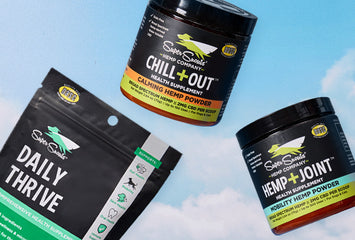
Chill + Out is built for predictable stress events — fireworks, thunderstorms, vet visits, travel. The chew brings together L-tryptophan, chamomile, passionflower, and broad-spectrum hemp (THC removed to non-detectable levels) and works best 30 to 60 minutes before the trigger. For households that prefer to skip hemp, routine consistency, structured exercise, and desensitization training handle most of what's needed for Standard Poodles.
Immunity and long-term wellness: medicinal mushrooms
Large breeds like the Standard Poodle benefit from proactive immune support earlier than most owners expect. Cognitive sharpness holds up well in the breed; joint support and skin/coat maintenance are the main senior priorities.
The immune category with the most solid research footprint is medicinal mushrooms. Reishi, turkey tail, shiitake, and maitake each deliver beta-glucans that appear to modulate canine immune responses — bringing overactive immune behavior down and supporting underactive pathways. Turkey tail has a notable track record in veterinary oncology nutrition; reishi has research support for helping senior dogs through normal aging. A blend covers multiple mechanisms. Super Shrooms — the same product on the skin side — pulls triple duty here, which is why it's in our routine recommendations for middle-aged and senior Standard Poodles.
Building a realistic routine
A stacked-high supplement bowl isn't realistic, and isn't required. For a healthy adult Standard Poodle, a practical starter routine comes down to three products: a daily joint supplement built on green-lipped mussel (effectively non-optional for most breeds as they age), a digestive product matched to the actual pattern (Firm Up! for stool consistency, G.I. Balance for gas, Pumpkin Latte for reflux), and a mushroom blend for skin and long-term immune support from middle age on. Calming chews stay in reserve for the predictable stress events: fireworks, thunderstorms, vet days.
One more thing worth saying out loud: the routine above is the Standard Poodle's routine, not a universal one. It targets what the breed is demonstrably at elevated risk for — joint and mobility, digestive health, skin and coat, calming support, and long-term immune support — and stops there. Adding products outside that list doesn't produce better outcomes; it produces more work for the owner and more cost for the same result. The goal is fewer daily supplements chosen deliberately, not more supplements hedging across categories the breed doesn't face. That's the difference between a supplement plan and a supplement habit.
Two things matter. First, dose correctly. Every product in this guide is dosed by body weight, and owners routinely err low — for a Standard Poodle at 40-70 lbs, that means the full weight-matched amount, not a generic pinch. Second, supplements aren't a substitute for the basics. Diet, weight management, exercise, and routine vet care carry the bulk of the work. Supplements are precision additions on top. And most of these ingredients compound over weeks, not days — consistency matters more than any single dose.
A solid Standard Poodle supplement plan is more surgical than comprehensive. It's short, it's aimed at the breed's actual risk exposures, and it pairs those exposures with ingredients that have real evidence behind them. Nothing else earns a place.