

A Shiba Inu doesn't fit neatly into a generic pet-wellness template. The Shiba Inu is the smallest of Japan's native spitz breeds, originally developed to hunt small game in mountainous terrain. The breed nearly went extinct during WWII and was reconstructed from three remaining bloodlines. The breed's working history still shows up in its body and temperament today, and that's the starting point for any supplement routine worth building.
The marketing trick in pet wellness is to make shelves look exhaustive. The actual answer for a Shiba Inu is narrower than most labels would suggest — a handful of ingredients that earn their place on evidence. Here's what that short list looks like, broken out by category.
Why Shiba Inus need a tailored supplement plan
Small breeds like the Shiba Inu, usually 17-23 lbs as adults, face their own risk profile: spinal and joint issues that look different from large-breed problems, plus metabolic and dental concerns. The small-dog assumption — that they don't need much — is the assumption that most often gets proven wrong at the 10-year mark. On top of the physical profile, the Shiba Inu is a primitive spitz breed with strong independence — a disposition that shapes how stress, exercise load, and recovery all play out day to day.
Read the above as planning material, not doom. A well-cared-for Shiba Inu has a 12-15 years lifespan to look forward to. The supplement decisions that matter are the ones that match the breed's actual risk profile — everything outside that is optional at best.
Across the research and our own customer data, two categories drive the supplement decisions that matter for a Shiba Inu: skin and coat and calming support.
Skin and coat: omega-3s, quercetin, and functional mushrooms
The Shiba Inu's double coat is a real advantage in many climates — and a liability in others. The thick double coat is built for cold climates — Shibas often struggle with heat and show skin inflammation in hot weather.
For canine skin health, the best-supported ingredients cluster in three groups. Omega-3 fatty acids — EPA and DHA in particular — reinforce the skin's barrier and soften the pathways that drive itching. Quercetin, a plant flavonoid sometimes marketed as 'nature's Benadryl,' is studied for supporting a normal histamine response. And beta-glucans from functional mushrooms (reishi, turkey tail, chaga, shiitake, lion's mane, maitake, cordyceps) appear to modulate the overactive immune response that's usually what 'seasonal allergies' actually are.
For a Shiba Inu whose allergies show up seasonally, Super Shrooms is usually our first recommendation: seven mushrooms, one inactive ingredient, sprinkled on food. The same product that handles skin support covers broader immune modulation, cutting the routine down to one product instead of two.
Rule out the upstream stuff first. Skin problems point at food allergies, environmental triggers, or fleas more often than owners expect. Supplements won't out-run a mismatched diet. With the basics in place, the two categories that most reliably move skin in the right direction within a few weeks are omega-3s and mushroom-derived beta-glucans.
Calming: L-tryptophan, chamomile, and the GABA pathway
Shiba Inus are athletic first, affectionate second — the stress signature reflects that. Shibas are known for 'Shiba screams' — a vocalized stress response that's real and breed-typical.
The point of a calming supplement isn't to sedate — it's to support the nervous-system pathways that regulate stress. L-tryptophan is the amino-acid precursor to serotonin. L-theanine fosters alpha-wave activity tied to relaxed focus. Chamomile and passionflower have long historical use for mild anxiety, with growing canine literature. Hemp-derived compounds have increasing research backing for reducing situational stress.
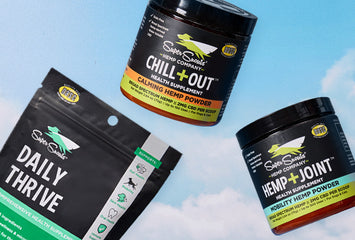
Designed for anticipatable stress, Chill + Out stacks L-tryptophan, chamomile, passionflower, and broad-spectrum hemp (THC removed to non-detectable levels) in a single chew. Give it 30 to 60 minutes before fireworks, thunderstorms, vet visits, or travel. When hemp isn't on the table, routine consistency, structured exercise, and desensitization training still handle the bulk of what Shiba Inus need.
Building a realistic routine
A bowl loaded with supplements every morning isn't a routine anyone keeps up. The realistic core for a healthy adult Shiba Inu is one product: a mushroom blend for skin and allergy support. Calming support lives on the shelf for when it's actually needed — fireworks, storms, travel.
A final point on scope: this routine is built around the Shiba Inu's actual exposure profile — skin and coat and calming support. The decision not to bolt on additional categories is deliberate. A shorter list that matches the breed's risks outperforms a longer list that hedges across categories the breed doesn't face. That's why we don't recommend a one-size-fits-all daily stack — and why the Shiba Inu's routine has the exact shape it does and no other.
Two things actually drive whether this works. First, get the dose right for the dog. All of these products are weight-based, and the modal mistake is underdosing — a Shiba Inu at 17-23 lbs needs the weight-matched serving, not a cautious sprinkle. Second, supplements sit on top of the fundamentals: diet, weight management, exercise, routine vet care. They don't replace them. Expect results on a four-to-eight-week timeline, and treat consistency as more important than precision.
For a Shiba Inu, a supplement routine earns its place by targeting the breed's real risks with ingredients backed by actual research. Longer lists aren't better; better-fit lists are.