

Generic wellness plans weren't built with the Pug in mind. The Pug originated in China, where emperors kept them as companions. The breed was imported to Europe in the 16th century and became a favorite of royalty. The flat face, curled tail, and compact build are all centuries old. That history isn't trivia — it's the reason the breed's modern health profile looks the way it does, and it's where any useful supplement plan has to start.
Most of what gets sold as 'wellness' is noise. The formulas that actually move the needle for a Pug are built around a short list of well-supported ingredients at the right doses. Here's that short list, category by category.
Why Pugs need a tailored supplement plan
Small breeds like the Pug, usually 14-18 lbs as adults, face their own risk profile: spinal and joint issues that look different from large-breed problems, plus metabolic and dental concerns. The small-dog assumption — that they don't need much — is the assumption that most often gets proven wrong at the 10-year mark. On top of the physical profile, the Pug is a brachycephalic toy breed bred purely for companionship — a disposition that shapes how stress, exercise load, and recovery all play out day to day.
None of this means the breed is fragile. A Pug usually has a 12-15 years lifespan of good years ahead with the right care. What separates supplements that earn their place from the rest is whether they address the breed's specific risks or hedge vaguely across a generic middle.
Everything supplement-related for a Pug routes through three main areas: joint and mobility, digestive health, and skin and coat.
Joint and mobility: glucosamine, chondroitin, and green-lipped mussel
Joint health matters for Pugs, even if the breed isn't in the highest risk tier. Patellar luxation, hip dysplasia, and Pug myelopathy (a spinal condition specific to the breed) are all documented. The most common mistake owners make is waiting for visible stiffness before starting support — by then, the underlying wear has usually been developing for years.
Dig into the canine joint literature and three ingredients keep surfacing: glucosamine, chondroitin sulfate, and MSM (methylsulfonylmethane). Glucosamine contributes to cartilage synthesis. Chondroitin sulfate protects cartilage's ability to cushion joints under load. MSM supplies sulfur essential to connective tissue. A formula missing any of them hasn't fully delivered.
Green-lipped mussel (GLM) pulls double duty. It's one of the richest natural sources of both glucosamine and chondroitin, and it delivers omega-3 fatty acids — including ETA, which is hard to get elsewhere — that support a balanced inflammatory response. Clinical work over 8 to 12 weeks has documented measurable improvements in joint comfort in supplemented dogs. For a breed the size of the Pug, that single-ingredient efficiency matters.
Joint Power takes the single-ingredient approach on purpose: 100% New Zealand green-lipped mussel, cold-processed and lipid-stabilized. Nothing synthetic. No fillers. It's delivered as a food topper so dosing a 18 lbs dog doesn't require a pill-wrestling match.
Pugs often carry their joints well into their senior years, but patellar and spinal issues can develop earlier than expected. Starting support around age four is reasonable for most small breeds.
Digestive health: stool consistency, gas, and acid reflux are three different problems
Pugs swallow air when they eat and often have chronic flatulence — the breed is also prone to food allergies and weight-related digestive issues. The Pug isn't in the high bloat-risk tier, but that doesn't mean digestion is irrelevant — stool consistency, gas, and occasional upset are still the most common daily complaints owners raise.
The digestive tract isn't a side system — it's upstream of most of what owners notice elsewhere. Skin, mood, energy, and immunity all bend to gut health. Inside the broad 'digestive issues' label live three different patterns: stool consistency, gas and bloating, and acid reflux. Each needs its own ingredient approach.
Pumpkin remains the go-to for stool consistency because it works on both loose and dry stool through one ingredient. Soluble fiber slows things down; insoluble fiber builds bulk. Firm Up! is how we deliver that straight: dried pumpkin and dried apple, full stop. The ingredient list is the formula, not a marketing feature.
For gas, bloating, and occasional tummy churn, you need ingredients that both feed beneficial microbes and ease smooth-muscle tension. Agave inulin is the prebiotic workhorse; fennel and ginger are classical carminatives with supporting canine data; apple pectin fills out the soluble-fiber side. G.I. Balance combines all of them: pumpkin, apple pectin, organic fennel seed, ginger, and organic agave inulin.
Acid reflux asks for a different ingredient answer than stool or gas issues. Goat milk takes the edge off stomach acid and delivers bioavailable nutrition; pumpkin adds mucosal soothing. Pumpkin Latte packages both in one daily option — the practical choice for Pugs with morning bile, reflux signs, or occasional vomiting.
Skin and coat: omega-3s, quercetin, and functional mushrooms
Breeds with facial folds like the Pug have a skin profile that needs daily maintenance, not seasonal. Facial fold dermatitis is nearly universal without daily care. The breed is also prone to atopic dermatitis and demodex.
The most evidence-backed ingredients for canine skin support are omega-3 fatty acids — EPA and DHA specifically — which reinforce the skin barrier and help regulate the biochemical pathways that drive itching. Quercetin, a plant flavonoid sometimes labeled 'nature's Benadryl,' has research supporting a normal histamine response. Functional mushrooms — reishi, turkey tail, chaga, shiitake, lion's mane, maitake, cordyceps — contribute beta-glucans that modulate overactive immune responses, which is usually what 'seasonal allergies' actually are at the cellular level.
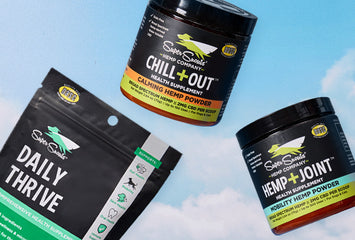
Super Shrooms is built on seven mushroom species plus one inactive ingredient. That's it. It sprinkles on the food bowl and covers two categories in one scoop: skin support plus whole-system immune modulation. For Pugs whose allergies come and go with the seasons, it's an efficient daily stand-in.
Work upstream before you work downstream. A skin-support supplement can't fix food allergies, environmental triggers, or a flea issue — and those drive the majority of canine skin complaints. When the basics are sorted, omega-3 fatty acids and mushroom-derived beta-glucans are the combination that most reliably turns skin around in a few weeks.
Building a realistic routine
A supplement routine has to be sustainable to do any good. For a healthy adult Pug, that usually means holding the line at three products: a daily joint supplement built on green-lipped mussel (effectively non-optional for most breeds as they age), a digestive product matched to the actual pattern (Firm Up! for stool consistency, G.I. Balance for gas, Pumpkin Latte for reflux), and a mushroom blend for skin and allergy support.
One caveat worth calling out: the plan above is the Pug's plan, not a standard multi-breed stack. It maps to joint and mobility, digestive health, and skin and coat and stops there because those are the categories where the breed carries real documented risk. Extending the routine beyond those categories adds cost and complication without improving outcomes — and a supplement plan that gets skipped because it's too much isn't a supplement plan at all.
Two rules tend to make or break outcomes. One — dose to the dog's actual weight. A Pug at 14-18 lbs needs the full weight-matched serving; underdosing is the most common mistake we see. Two — supplements are additions, not substitutes. They won't fix a mismatched diet, chronic over- or under-feeding, or skipped vet care. Get the fundamentals right first, then layer targeted supplements on top. And give them time — most of the ingredients in this guide take four to eight weeks to show their full effect.
For a Pug, the supplement plan that holds up isn't a longer one — it's a better-targeted one. Match documented breed risks to the ingredients with the research to address them. That's the shape a useful routine takes.