

Before you stock the supplement shelf for a Pit Bull, it helps to understand where the breed actually came from. Pit Bull is an umbrella term — American Pit Bull Terrier, American Staffordshire Terrier, Staffordshire Bull Terrier, American Bully — with shared bulldog-and-terrier ancestry. The build is muscular, athletic, and historically versatile. Those origins aren't historical flavor — they're the reason the breed has the specific health considerations it does today.
Most advice in this space confuses length with rigor; a 15-ingredient label gets treated as proof of quality. It rarely is. Here's what a Pit Bull actually needs day to day — with the reasoning behind each choice, and no filler.
Why Pit Bulls need a tailored supplement plan
Medium breeds like the Pit Bull, typically 35-70 lbs at adulthood, sit in a sweet spot for lifespan — but breed-specific risks still show up, and generic formulas miss them. The dogs that thrive into their teens are almost always the ones whose owners planned for the breed's known weaknesses from the start. On top of the physical profile, the Pit Bull is an athletic working-line breed with real muscle mass — a disposition that shapes how stress, exercise load, and recovery all play out day to day.
Context matters more than worry: a Pit Bull with thoughtful care generally lives a 10-14 years lifespan in solid shape. The supplement line-up that supports that outcome is specific to the breed's risks, not borrowed from a generic multi-breed default.
The short list of supplement areas that matter for a Pit Bull comes out to two: joint and mobility and skin and coat.
Joint and mobility: glucosamine, chondroitin, and green-lipped mussel
Joint health matters for Pit Bulls, even if the breed isn't in the highest risk tier. Hip dysplasia and cruciate tears are tracked issues, and the breed's high pain tolerance can mask joint problems until they're advanced. The most common mistake owners make is waiting for visible stiffness before starting support — by then, the underlying wear has usually been developing for years.
Dig into the canine joint literature and three ingredients keep surfacing: glucosamine, chondroitin sulfate, and MSM (methylsulfonylmethane). Glucosamine contributes to cartilage synthesis. Chondroitin sulfate protects cartilage's ability to cushion joints under load. MSM supplies sulfur essential to connective tissue. A formula missing any of them hasn't fully delivered.
Within the joint category, green-lipped mussel is the rare ingredient that earns its spot on multiple mechanisms at once. It's a concentrated natural source of glucosamine and chondroitin and provides the unusual omega-3 ETA, supporting a balanced inflammatory response. Peer-reviewed studies over 8 to 12 weeks have produced measurable joint-comfort gains. That single-ingredient coverage is a real advantage for a Pit Bull.
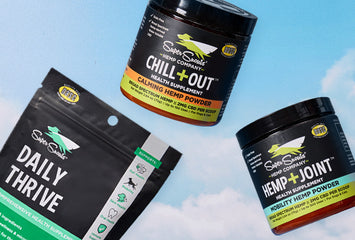
Joint Power exists because the best-supported joint ingredient didn't need a dozen co-stars. It's 100% New Zealand green-lipped mussel, cold-processed and lipid-stabilized. No synthetic glucosamine, no fillers. It's delivered as a food topper, which makes a 70 lbs dog's daily routine easier than a chew-plus-pill stack.
For a Pit Bull, starting joint support by age four or five is a reasonable default. High-drive or working-line dogs benefit from earlier intervention.
Skin and coat: omega-3s, quercetin, and functional mushrooms
Short-coated breeds like the Pit Bull still need skin support. Pit Bulls have one of the higher rates of environmental and food allergies in the breed rankings, often manifesting as chronic ear infections and paw licking.
On canine skin, a short list of ingredients does the heaviest lifting. EPA and DHA omega-3 fatty acids support the skin barrier and tamp down the pathways that drive itch. Quercetin, a plant flavonoid, has research behind its support for a normal histamine response — hence the 'nature's Benadryl' nickname. Beta-glucans from functional mushrooms (reishi, turkey tail, chaga, shiitake, lion's mane, maitake, cordyceps) appear to modulate the overactive immune activity that underlies 'seasonal allergies.'
Super Shrooms is the seven-mushroom blend we formulate for exactly this — with one inactive ingredient, and nothing else. It tops food and works across two fronts: skin support and broader immune modulation. For a Pit Bull whose allergies track the seasons, it's the routine daily option.
Don't reach for a skin supplement before the basics are sorted. Food allergies, environmental triggers, and fleas explain more canine skin problems than owners expect, and no supplement undoes those. With the foundations in place, omega-3 fatty acids and mushroom-derived beta-glucans are the two ingredient categories that most reliably produce visible change within a few weeks.
Building a realistic routine
An honest supplement routine is short, not long. For a healthy adult Pit Bull, that looks like two products: a daily joint supplement built on green-lipped mussel (effectively non-optional for most breeds as they age) and a mushroom blend for skin and allergy support.
Final framing on scope: the routine above is breed-specific by design. It's matched to joint and mobility and skin and coat — the areas where the Pit Bull has a documented predisposition — and doesn't extend beyond. Adding generic products past that point just raises the cost and reduces adherence without improving anything. The goal here is shorter, better-targeted supplementation, not more of it.
Two practical notes decide whether this actually works. One, dose to weight — the products in this guide are formulated that way, and underdosing is the near-universal error. A Pit Bull at 35-70 lbs needs the full weight-matched amount. Two, supplements sit on top of the basics: quality diet, body-weight management, appropriate exercise, routine veterinary care. If any of those are shaky, supplements can't compensate. And plan on a four-to-eight-week window for noticeable changes.
A well-designed supplement plan for a Pit Bull doesn't look like more — it looks like fewer, chosen carefully. The products that matter are the ones that match a real breed risk to an ingredient with research behind it. The rest is filler.