

Owners who treat a Maltese like a generic dog end up with a generic wellness routine — and wonder why it doesn't seem to fit. The Maltese is one of the oldest toy breeds, with references going back to ancient Greece and Rome. The breed was developed purely as a companion — the white, silky coat is the signature. The breed's development story is the most honest starting point for figuring out what supplements actually matter.
Strip away the marketing copy and canine supplement science rests on a small set of ingredients with real data behind them. For a Maltese, those are the ones worth building a routine around. Here's the walkthrough, one category at a time.
Why Malteses need a tailored supplement plan
Toy breeds like the Maltese, weighing just 4-7 lbs as adults, don't get a free pass on health risks. Their profile is just different — cartilage, dental, and metabolic concerns often dominate. Toy dogs also live longer on average, which means more time for small issues to compound into real ones. On top of the physical profile, the Maltese is an ancient toy breed bred exclusively for companionship — a disposition that shapes how stress, exercise load, and recovery all play out day to day.
Risk profiles like this don't mean the breed is delicate. Malteses live a 12-15 years lifespan typically, and a lot of that is within the owner's control. Supplements that address the breed's documented risks move outcomes; supplements chosen because they look comprehensive rarely do.
Four areas consistently show up as high-leverage for a Maltese: joint and mobility, digestive health, skin and coat, and calming support.
Joint and mobility: glucosamine, chondroitin, and green-lipped mussel
Joint health matters for Malteses, even if the breed isn't in the highest risk tier. Patellar luxation and Legg-Calvé-Perthes disease are both documented. The most common mistake owners make is waiting for visible stiffness before starting support — by then, the underlying wear has usually been developing for years.
Start with the short list of joint ingredients with real clinical backing: glucosamine, chondroitin sulfate, and MSM (methylsulfonylmethane). Glucosamine supplies the amino sugar cartilage is built from. Chondroitin sulfate gives cartilage its resilience under compression. MSM provides the sulfur that connective tissue depends on. These three form the foundation of any serious canine joint supplement.
Green-lipped mussel earns its place in joint formulas on the strength of what it packs into one ingredient. It's a natural source of glucosamine and chondroitin and brings omega-3 fatty acids — notably the less common ETA — that support a balanced inflammatory response. Dogs supplemented with green-lipped mussel have shown measurable joint-comfort gains in peer-reviewed 8-to-12-week trials. For a Maltese, that multi-mechanism coverage from a single input is rare.
That's the thinking behind Joint Power: a single-ingredient product — 100% New Zealand green-lipped mussel, cold-processed and lipid-stabilized to protect the omega-3 profile. No synthetic glucosamine, no fillers. The sprinkle-on-food format is the one most owners actually maintain, especially for a 7 lbs dog who doesn't love pills.
Toy breeds like the Maltese rarely show joint issues early, but when issues appear (most commonly patellar luxation), they compound. Starting joint support by age four or five is a reasonable default.
Digestive health: stool consistency, gas, and acid reflux are three different problems
Hypoglycemia risk in young Maltese and pancreatitis in adults are the two most common digestive concerns. The Maltese isn't in the high bloat-risk tier, but that doesn't mean digestion is irrelevant — stool consistency, gas, and occasional upset are still the most common daily complaints owners raise.
Good digestion is the baseline the rest of canine wellness sits on. When the gut drifts, secondary systems drift with it. The daily gripe of 'digestive issues' almost always reduces to one of three concrete patterns: stool consistency, gas and bloating, and acid reflux. Treating them with the same formula is a category error.
For stool consistency, pumpkin's dual-fiber profile is the most evidence-backed option we've found. Soluble fiber slows loose transit; insoluble fiber gives bulk when needed. Firm Up! keeps the label honest: dried pumpkin and dried apple, full stop. Most competing stool-support formulas fold in 11 or more ingredients. More inputs don't mean better outcomes — usually the reverse.
For gas, bloating, and low-grade GI unease, the tools change. Prebiotic fibers (like agave inulin) feed the beneficial microbes that keep the gut environment stable. Fennel and ginger have long-standing carminative use. Apple pectin contributes a mild soluble-fiber effect. G.I. Balance stacks those together: pumpkin, apple pectin, organic fennel seed, ginger, and organic agave inulin — veterinary-recommended and built for exactly this use case.
Acid reflux and vomit prevention get their own protocol. Goat milk has a buffering effect on stomach acid and adds bioavailable nutrients to the bowl; pumpkin provides coating and soothing on the mucosal side. Pumpkin Latte brings those together. It's the daily option we reach for in Malteses with morning bile, occasional vomit, or other reflux patterns.
Skin and coat: omega-3s, quercetin, and functional mushrooms
Silky-coated breeds like the Maltese have delicate skin beneath an elegant coat. The single-layer white coat needs regular maintenance and tear staining is common. Allergies affect the breed at above-average rates.
For canine skin health, the best-supported ingredients cluster in three groups. Omega-3 fatty acids — EPA and DHA in particular — reinforce the skin's barrier and soften the pathways that drive itching. Quercetin, a plant flavonoid sometimes marketed as 'nature's Benadryl,' is studied for supporting a normal histamine response. And beta-glucans from functional mushrooms (reishi, turkey tail, chaga, shiitake, lion's mane, maitake, cordyceps) appear to modulate the overactive immune response that's usually what 'seasonal allergies' actually are.
Super Shrooms is the single-product answer to both the skin-support and immune-modulation sides of allergy symptoms. Seven mushroom species, one inactive ingredient, sprinkled daily. For Malteses whose allergies follow a seasonal pattern, it's the straightforward daily choice.
Check the basics before layering on supplements — food allergies, environmental triggers, and fleas drive more skin complaints than any supplement can fix. That said, once the upstream factors are handled, the combination of omega-3 fatty acids and mushroom-derived beta-glucans is where most dogs see a real, visible improvement within a few weeks.
Calming: L-tryptophan, chamomile, and the GABA pathway
Small-breed anxiety is often dismissed as 'attitude' or reactivity. Maltese are often deeply bonded and can become reactive or anxious when routines change.
Calming ingredients don't knock a dog out — they support the biochemistry that makes calm possible. L-tryptophan feeds into serotonin synthesis. L-theanine shifts brain activity into alpha-wave territory, the signature of calm alertness. Chamomile and passionflower carry long traditional use for mild anxiety with some canine studies behind them. Hemp-derived compounds are increasingly backed for situational stress.
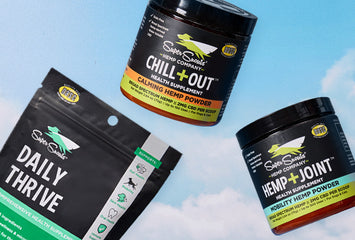
The product we use for predictable triggers — fireworks, thunderstorms, vet visits, travel — is Chill + Out. It's a chew formulated around L-tryptophan, chamomile, passionflower, and broad-spectrum hemp (THC stripped to non-detectable levels), dosed 30 to 60 minutes before the event. For hemp-averse households, a consistent routine plus structured exercise and desensitization work carry a Maltese a long way.
Building a realistic routine
Piling products on the food bowl isn't a routine that sticks. The practical starter stack for a healthy adult Maltese is three products: a daily joint supplement built on green-lipped mussel (effectively non-optional for most breeds as they age), a digestive product matched to the actual pattern (Firm Up! for stool consistency, G.I. Balance for gas, Pumpkin Latte for reflux), and a mushroom blend for skin and allergy support. Calming chews belong in reserve — dosed ahead of fireworks, vet days, or travel, not given every morning.
Worth reiterating: a Maltese's routine isn't the same as a generic multi-breed routine. This one is targeted at joint and mobility, digestive health, skin and coat, and calming support — the categories where the breed has a documented predisposition. Adding products outside that list tends to dilute adherence without moving outcomes. If the Maltese develops a specific issue later in life outside the categories above, that's the point to add a targeted supplement — with guidance from a vet — rather than building from a maximalist default that the breed doesn't actually need.
Two points carry most of the weight here. First, dose accurately. The products in this guide are dosed by body weight, and underdosing is a far more common error than overdosing — a Maltese at 4-7 lbs needs the full weight-matched amount. Second, these are additions to the fundamentals, not alternatives: quality diet, healthy body weight, appropriate exercise, and routine vet care do the heavy lifting. Supplements refine what's already working, and most compound across four to eight weeks rather than days.
What works for a Maltese is a lean, breed-specific supplement plan — real risks matched with real-research ingredients, and the rest left off the list entirely.