

A Jack Russell Terrier doesn't fit neatly into a generic pet-wellness template. The Jack Russell Terrier was developed in 19th-century England for fox hunting — a small, bold terrier that could follow quarry into the earth. The breed retains the athletic drive and tenacity. The breed's working history still shows up in its body and temperament today, and that's the starting point for any supplement routine worth building.
The marketing trick in pet wellness is to make shelves look exhaustive. The actual answer for a Jack Russell Terrier is narrower than most labels would suggest — a handful of ingredients that earn their place on evidence. Here's what that short list looks like, broken out by category.
Why Jack Russell Terriers need a tailored supplement plan
Small breeds like the Jack Russell Terrier, usually 13-17 lbs as adults, face their own risk profile: spinal and joint issues that look different from large-breed problems, plus metabolic and dental concerns. The small-dog assumption — that they don't need much — is the assumption that most often gets proven wrong at the 10-year mark. On top of the physical profile, the Jack Russell Terrier is a small working terrier with outsized drive — a disposition that shapes how stress, exercise load, and recovery all play out day to day.
Read the above as planning material, not doom. A well-cared-for Jack Russell Terrier has a 13-16 years lifespan to look forward to. The supplement decisions that matter are the ones that match the breed's actual risk profile — everything outside that is optional at best.
Across the research and our own customer data, three categories drive the supplement decisions that matter for a Jack Russell Terrier: joint and mobility, skin and coat, and calming support.
Joint and mobility: glucosamine, chondroitin, and green-lipped mussel
Joint health matters for Jack Russell Terriers, even if the breed isn't in the highest risk tier. Patellar luxation and Legg-Calvé-Perthes disease (a hip condition in small breeds) are both documented. The most common mistake owners make is waiting for visible stiffness before starting support — by then, the underlying wear has usually been developing for years.
The evidence for canine joint support rests on three ingredients: glucosamine, chondroitin sulfate, and MSM (methylsulfonylmethane). Glucosamine feeds into the cartilage matrix itself. Chondroitin sulfate keeps cartilage hydrated and cushioned under load. MSM contributes sulfur to connective-tissue structure. A joint formula that skips any of the three is missing part of the picture.
For single-ingredient efficiency, green-lipped mussel is hard to beat. It's a concentrated source of glucosamine and chondroitin and carries an omega-3 profile — including ETA, which standard fish oil doesn't deliver — that supports a balanced inflammatory response. Veterinary studies running 8 to 12 weeks have shown meaningful joint-comfort improvements in dogs taking GLM. For a Jack Russell Terrier, that one-ingredient coverage is especially useful.
Everything in Joint Power is one ingredient and two process steps: New Zealand green-lipped mussel, cold-processed and lipid-stabilized. No synthetic glucosamine substitutes, no filler packing the scoop. It tops food rather than sits in a chew, which fits most 17 lbs-size routines better.
Jack Russell Terriers often carry their joints well into their senior years, but patellar and spinal issues can develop earlier than expected. Starting support around age four is reasonable for most small breeds.
Skin and coat: omega-3s, quercetin, and functional mushrooms
Short-coated breeds like the Jack Russell Terrier still need skin support. The smooth, broken, or rough coat varieties all offer limited skin protection; atopy is a documented concern.
Three categories of ingredient carry the most weight for canine skin health: omega-3 fatty acids in the EPA/DHA form to bolster the skin barrier and dial down the pathways driving itch; quercetin, a plant flavonoid studied for its support of a normal histamine response (and sometimes called 'nature's Benadryl'); and beta-glucans from medicinal mushrooms like reishi, turkey tail, chaga, shiitake, lion's mane, maitake, and cordyceps, which appear to modulate the overactive immune behavior that sits behind most 'seasonal allergies.'
For a Jack Russell Terrier whose allergies show up seasonally, Super Shrooms is usually our first recommendation: seven mushrooms, one inactive ingredient, sprinkled on food. The same product that handles skin support covers broader immune modulation, cutting the routine down to one product instead of two.
Rule out the upstream stuff first. Skin problems point at food allergies, environmental triggers, or fleas more often than owners expect. Supplements won't out-run a mismatched diet. With the basics in place, the two categories that most reliably move skin in the right direction within a few weeks are omega-3s and mushroom-derived beta-glucans.
Calming: L-tryptophan, chamomile, and the GABA pathway
Jack Russell Terriers are athletic first, affectionate second — the stress signature reflects that. Jack Russells without work find their own — often destructive — jobs. Mental stress baseline is higher than the breed's image suggests.
The point of a calming supplement isn't to sedate — it's to support the nervous-system pathways that regulate stress. L-tryptophan is the amino-acid precursor to serotonin. L-theanine fosters alpha-wave activity tied to relaxed focus. Chamomile and passionflower have long historical use for mild anxiety, with growing canine literature. Hemp-derived compounds have increasing research backing for reducing situational stress.
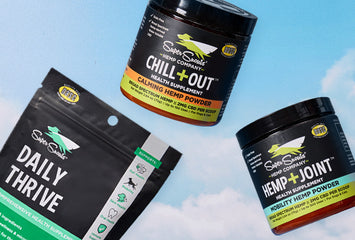
Designed for anticipatable stress, Chill + Out stacks L-tryptophan, chamomile, passionflower, and broad-spectrum hemp (THC removed to non-detectable levels) in a single chew. Give it 30 to 60 minutes before fireworks, thunderstorms, vet visits, or travel. When hemp isn't on the table, routine consistency, structured exercise, and desensitization training still handle the bulk of what Jack Russell Terriers need.
Building a realistic routine
A bowl loaded with supplements every morning isn't a routine anyone keeps up. The realistic core for a healthy adult Jack Russell Terrier is two products: a daily joint supplement built on green-lipped mussel (effectively non-optional for most breeds as they age) and a mushroom blend for skin and allergy support. Calming support lives on the shelf for when it's actually needed — fireworks, storms, travel.
A final point on scope: this routine is built around the Jack Russell Terrier's actual exposure profile — joint and mobility, skin and coat, and calming support. The decision not to bolt on additional categories is deliberate. A shorter list that matches the breed's risks outperforms a longer list that hedges across categories the breed doesn't face. That's why we don't recommend a one-size-fits-all daily stack — and why the Jack Russell Terrier's routine has the exact shape it does and no other.
Two things actually drive whether this works. First, get the dose right for the dog. All of these products are weight-based, and the modal mistake is underdosing — a Jack Russell Terrier at 13-17 lbs needs the weight-matched serving, not a cautious sprinkle. Second, supplements sit on top of the fundamentals: diet, weight management, exercise, routine vet care. They don't replace them. Expect results on a four-to-eight-week timeline, and treat consistency as more important than precision.
For a Jack Russell Terrier, a supplement routine earns its place by targeting the breed's real risks with ingredients backed by actual research. Longer lists aren't better; better-fit lists are.