

Before you stock the supplement shelf for a Chihuahua, it helps to understand where the breed actually came from. The Chihuahua is the oldest breed in the Americas, with roots going back to the Techichi dogs of ancient Mexico. Modern Chihuahuas come in a range of coat and color variations but share the tiny frame and outsized personality. Those origins aren't historical flavor — they're the reason the breed has the specific health considerations it does today.
Most advice in this space confuses length with rigor; a 15-ingredient label gets treated as proof of quality. It rarely is. Here's what a Chihuahua actually needs day to day — with the reasoning behind each choice, and no filler.
Why Chihuahuas need a tailored supplement plan
Toy breeds like the Chihuahua, weighing just 3-6 lbs as adults, don't get a free pass on health risks. Their profile is just different — cartilage, dental, and metabolic concerns often dominate. Toy dogs also live longer on average, which means more time for small issues to compound into real ones. On top of the physical profile, the Chihuahua is the world's smallest dog breed with a Napoleonic attitude — a disposition that shapes how stress, exercise load, and recovery all play out day to day.
Context matters more than worry: a Chihuahua with thoughtful care generally lives a 14-16 years lifespan in solid shape. The supplement line-up that supports that outcome is specific to the breed's risks, not borrowed from a generic multi-breed default.
The short list of supplement areas that matter for a Chihuahua comes out to four: joint and mobility, digestive health, skin and coat, and calming support.
Joint and mobility: glucosamine, chondroitin, and green-lipped mussel
Joint health matters for Chihuahuas, even if the breed isn't in the highest risk tier. Patellar luxation is extremely common in the breed — by some estimates affecting a majority of Chihuahuas at some level. The most common mistake owners make is waiting for visible stiffness before starting support — by then, the underlying wear has usually been developing for years.
Clinical literature on canine joint care keeps coming back to the same three ingredients: glucosamine, chondroitin sulfate, and MSM (methylsulfonylmethane). Glucosamine feeds cartilage synthesis. Chondroitin sulfate maintains the water content that gives cartilage its cushion. MSM is the sulfur source connective tissue depends on. Cutting one of the three shortens the odds the formula actually works.
Green-lipped mussel punches above its weight. It delivers glucosamine and chondroitin naturally, adds ETA-containing omega-3 fatty acids that support a balanced inflammatory response, and carries real clinical backing: 8-to-12-week canine trials have shown measurable joint-comfort improvements. For a Chihuahua, covering multiple mechanisms with one ingredient simplifies the whole routine.
Joint Power exists because the best-supported joint ingredient didn't need a dozen co-stars. It's 100% New Zealand green-lipped mussel, cold-processed and lipid-stabilized. No synthetic glucosamine, no fillers. It's delivered as a food topper, which makes a 6 lbs dog's daily routine easier than a chew-plus-pill stack.
Toy breeds like the Chihuahua rarely show joint issues early, but when issues appear (most commonly patellar luxation), they compound. Starting joint support by age four or five is a reasonable default.
Digestive health: stool consistency, gas, and acid reflux are three different problems
Hypoglycemia risk in young and small Chihuahuas means regular meals matter. Pancreatitis risk is real too. The Chihuahua isn't in the high bloat-risk tier, but that doesn't mean digestion is irrelevant — stool consistency, gas, and occasional upset are still the most common daily complaints owners raise.
Treat the gut as the base layer — not a bonus category. A disrupted digestive tract shows up as lower energy, duller coat, and a less stable mood, not just as soft stools. When owners flag 'digestive issues,' the underlying picture is usually one of three: stool-consistency swings, gas and bloating, or acid reflux. Each pattern has its own ingredient playbook.
Addressing stool consistency really does come back to dried pumpkin. The dual-fiber profile handles loose and firm stools through the same ingredient. Firm Up! commits to the approach: two ingredients, dried pumpkin and dried apple, and nothing extra. A shorter label isn't a shortage — it's restraint.
To address gas, bloating, or low-grade GI upset in a Chihuahua, lean on prebiotics plus carminatives. Agave inulin feeds beneficial microbes selectively. Fennel and ginger have traditional carminative use with some modern backing. Apple pectin adds soluble fiber. G.I. Balance pulls them together: pumpkin, apple pectin, organic fennel seed, ginger, and organic agave inulin — veterinary-recommended for exactly this symptom pattern.
Reflux and occasional vomiting don't respond the same way stool or gas issues do. Goat milk gently buffers stomach acid while contributing bioavailable nutrients; pumpkin provides the soothing, coating action that makes a difference to an irritated GI lining. Pumpkin Latte combines both and is the product we reach for in Chihuahuas with recurrent bile or morning-vomit patterns.
Skin and coat: omega-3s, quercetin, and functional mushrooms
Short-coated breeds like the Chihuahua still need skin support. Both coat varieties (smooth and long) have skin sensitivities — Chihuahuas are among the breeds most commonly diagnosed with atopy.
Three ingredient families dominate the canine skin-health literature. Omega-3 fatty acids — the EPA/DHA pair — reinforce the skin barrier and dial back itch-promoting signaling. Quercetin (the flavonoid known as 'nature's Benadryl') has research support for a normal histamine response. Beta-glucans from medicinal mushrooms like reishi, turkey tail, chaga, shiitake, lion's mane, maitake, and cordyceps appear to modulate the overactive immune responses that tend to sit behind 'seasonal allergies.'
Super Shrooms is the seven-mushroom blend we formulate for exactly this — with one inactive ingredient, and nothing else. It tops food and works across two fronts: skin support and broader immune modulation. For a Chihuahua whose allergies track the seasons, it's the routine daily option.
Don't reach for a skin supplement before the basics are sorted. Food allergies, environmental triggers, and fleas explain more canine skin problems than owners expect, and no supplement undoes those. With the foundations in place, omega-3 fatty acids and mushroom-derived beta-glucans are the two ingredient categories that most reliably produce visible change within a few weeks.
Calming: L-tryptophan, chamomile, and the GABA pathway
Small-breed anxiety is often dismissed as 'attitude' or reactivity. Chihuahuas are often genuinely anxious rather than just reactive — the breed shows real elevated cortisol in stressful environments.
A calming supplement that does what it says works with the nervous system, not against it. L-tryptophan is the amino-acid precursor to serotonin. L-theanine produces the alpha-wave pattern associated with calm, focused alertness. Chamomile and passionflower have long-standing traditional use for mild anxiety with some canine research support. Hemp-derived compounds have growing literature for situational stress.
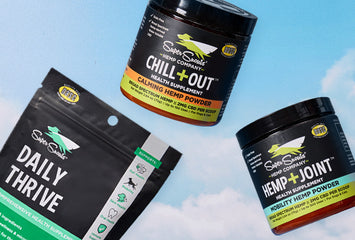
For predictable triggers — fireworks, thunderstorms, vet visits, travel — Chill + Out combines L-tryptophan, chamomile, passionflower, and broad-spectrum hemp (THC removed to non-detectable levels) in a chew. Give it 30 to 60 minutes before the trigger. If hemp isn't a fit for your household, consistent routines, structured exercise, and desensitization work are well worth the time for Chihuahuas.
Building a realistic routine
An honest supplement routine is short, not long. For a healthy adult Chihuahua, that looks like three products: a daily joint supplement built on green-lipped mussel (effectively non-optional for most breeds as they age), a digestive product matched to the actual pattern (Firm Up! for stool consistency, G.I. Balance for gas, Pumpkin Latte for reflux), and a mushroom blend for skin and allergy support. A calming chew stays on hand for the predictable flashpoints: storms, fireworks, vet days, travel.
Final framing on scope: the routine above is breed-specific by design. It's matched to joint and mobility, digestive health, skin and coat, and calming support — the areas where the Chihuahua has a documented predisposition — and doesn't extend beyond. Adding generic products past that point just raises the cost and reduces adherence without improving anything. The goal here is shorter, better-targeted supplementation, not more of it.
Two practical notes decide whether this actually works. One, dose to weight — the products in this guide are formulated that way, and underdosing is the near-universal error. A Chihuahua at 3-6 lbs needs the full weight-matched amount. Two, supplements sit on top of the basics: quality diet, body-weight management, appropriate exercise, routine veterinary care. If any of those are shaky, supplements can't compensate. And plan on a four-to-eight-week window for noticeable changes.
A well-designed supplement plan for a Chihuahua doesn't look like more — it looks like fewer, chosen carefully. The products that matter are the ones that match a real breed risk to an ingredient with research behind it. The rest is filler.