

Before you stock the supplement shelf for a Brittany, it helps to understand where the breed actually came from. The Brittany was developed in France's Brittany region as a pointing gun dog. The breed is smaller than most pointers and retrievers — fast, biddable, and built for long days in the field. Those origins aren't historical flavor — they're the reason the breed has the specific health considerations it does today.
Most advice in this space confuses length with rigor; a 15-ingredient label gets treated as proof of quality. It rarely is. Here's what a Brittany actually needs day to day — with the reasoning behind each choice, and no filler.
Why Brittanys need a tailored supplement plan
Medium breeds like the Brittany, typically 30-40 lbs at adulthood, sit in a sweet spot for lifespan — but breed-specific risks still show up, and generic formulas miss them. The dogs that thrive into their teens are almost always the ones whose owners planned for the breed's known weaknesses from the start. On top of the physical profile, the Brittany is a compact pointing breed with sporting-dog drive — a disposition that shapes how stress, exercise load, and recovery all play out day to day.
Context matters more than worry: a Brittany with thoughtful care generally lives a 12-14 years lifespan in solid shape. The supplement line-up that supports that outcome is specific to the breed's risks, not borrowed from a generic multi-breed default.
The short list of supplement areas that matter for a Brittany comes out to three: joint and mobility, skin and coat, and calming support.
Joint and mobility: glucosamine, chondroitin, and green-lipped mussel
Brittanys fare better than most breeds on orthopedic risk, but joint support still matters. Hip dysplasia is tracked but rates are lower than most sporting breeds. Starting support before problems appear is the whole point.
Canine joint science lands on three ingredients with the strongest track record: glucosamine, chondroitin sulfate, and MSM. Glucosamine is a building block of cartilage synthesis. Chondroitin sulfate helps cartilage retain water, which is what lets it cushion joints. MSM (methylsulfonylmethane) delivers sulfur that supports connective-tissue integrity. Skip one, and the formula is incomplete.
Green-lipped mussel is the joint input that does the most work per ingredient. It's a concentrated natural source of glucosamine and chondroitin and brings omega-3s — ETA included, which you won't find in standard fish oil — that support a balanced inflammatory response. Canine trials at 8 to 12 weeks have documented joint-comfort gains. That kind of cross-mechanism coverage is uncommon for a Brittany.
Joint Power exists because the best-supported joint ingredient didn't need a dozen co-stars. It's 100% New Zealand green-lipped mussel, cold-processed and lipid-stabilized. No synthetic glucosamine, no fillers. It's delivered as a food topper, which makes a 40 lbs dog's daily routine easier than a chew-plus-pill stack.
For a Brittany, starting joint support by age four or five is a reasonable default. High-drive or working-line dogs benefit from earlier intervention.
Skin and coat: omega-3s, quercetin, and functional mushrooms
Short-coated breeds like the Brittany still need skin support. The orange and white or liver and white coat is moderate-maintenance; seasonal allergies occur.
For canine skin, three ingredient categories carry the strongest research weight. Omega-3 fatty acids — specifically EPA and DHA — reinforce the skin barrier and quiet the pathways that drive itch. Quercetin, a plant flavonoid marketed as 'nature's Benadryl,' supports a normal histamine response. Beta-glucans from medicinal mushrooms — reishi, turkey tail, chaga, shiitake, lion's mane, maitake, and cordyceps — modulate the overactive immune behavior that sits under most 'seasonal allergies.'
Super Shrooms is the seven-mushroom blend we formulate for exactly this — with one inactive ingredient, and nothing else. It tops food and works across two fronts: skin support and broader immune modulation. For a Brittany whose allergies track the seasons, it's the routine daily option.
Don't reach for a skin supplement before the basics are sorted. Food allergies, environmental triggers, and fleas explain more canine skin problems than owners expect, and no supplement undoes those. With the foundations in place, omega-3 fatty acids and mushroom-derived beta-glucans are the two ingredient categories that most reliably produce visible change within a few weeks.
Calming: L-tryptophan, chamomile, and the GABA pathway
Brittanys are social and high-energy, which sometimes masks stress. Brittanys can be sensitive and may be noise-reactive, especially if not well-socialized.
A calming supplement that does what it says works with the nervous system, not against it. L-tryptophan is the amino-acid precursor to serotonin. L-theanine produces the alpha-wave pattern associated with calm, focused alertness. Chamomile and passionflower have long-standing traditional use for mild anxiety with some canine research support. Hemp-derived compounds have growing literature for situational stress.
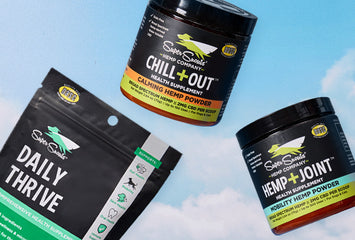
For predictable triggers — fireworks, thunderstorms, vet visits, travel — Chill + Out combines L-tryptophan, chamomile, passionflower, and broad-spectrum hemp (THC removed to non-detectable levels) in a chew. Give it 30 to 60 minutes before the trigger. If hemp isn't a fit for your household, consistent routines, structured exercise, and desensitization work are well worth the time for Brittanys.
Building a realistic routine
An honest supplement routine is short, not long. For a healthy adult Brittany, that looks like two products: a daily joint supplement built on green-lipped mussel (effectively non-optional for most breeds as they age) and a mushroom blend for skin and allergy support. A calming chew stays on hand for the predictable flashpoints: storms, fireworks, vet days, travel.
Final framing on scope: the routine above is breed-specific by design. It's matched to joint and mobility, skin and coat, and calming support — the areas where the Brittany has a documented predisposition — and doesn't extend beyond. Adding generic products past that point just raises the cost and reduces adherence without improving anything. The goal here is shorter, better-targeted supplementation, not more of it.
Two practical notes decide whether this actually works. One, dose to weight — the products in this guide are formulated that way, and underdosing is the near-universal error. A Brittany at 30-40 lbs needs the full weight-matched amount. Two, supplements sit on top of the basics: quality diet, body-weight management, appropriate exercise, routine veterinary care. If any of those are shaky, supplements can't compensate. And plan on a four-to-eight-week window for noticeable changes.
A well-designed supplement plan for a Brittany doesn't look like more — it looks like fewer, chosen carefully. The products that matter are the ones that match a real breed risk to an ingredient with research behind it. The rest is filler.