

If you've tried a generic wellness protocol on a Beagle and it hasn't landed, that's predictable. The Beagle was developed in England as a scenthound for hunting rabbits in packs. The breed's size, stamina, and legendary nose all trace back to that job. The dog in front of you carries that lineage in its build, metabolism, and temperament — and a supplement plan that doesn't respect that is starting from the wrong place.
Most supplement marketing reaches for long ingredient decks and vague benefit claims. What actually helps a Beagle is narrower — a short list of well-studied inputs at doses that match the dog in front of you. Here's the breakdown, category by category.
Why Beagles need a tailored supplement plan
Small breeds like the Beagle, usually 20-30 lbs as adults, face their own risk profile: spinal and joint issues that look different from large-breed problems, plus metabolic and dental concerns. The small-dog assumption — that they don't need much — is the assumption that most often gets proven wrong at the 10-year mark. On top of the physical profile, the Beagle is a scenthound with an obsessive appetite — a disposition that shapes how stress, exercise load, and recovery all play out day to day.
None of this should read as alarming. The typical Beagle clears a 12-15 years lifespan with room to spare when the basics are handled. Supplement choices either target real breed exposures or they don't — that distinction is what separates a working plan from a cluttered one.
Practically speaking, a Beagle's routine breaks into four useful supplement categories: joint and mobility, digestive health, skin and coat, and calming support.
Joint and mobility: glucosamine, chondroitin, and green-lipped mussel
Joint health matters for Beagles, even if the breed isn't in the highest risk tier. Intervertebral disc disease and hip dysplasia are both documented, made worse by the breed's tendency toward weight gain. The most common mistake owners make is waiting for visible stiffness before starting support — by then, the underlying wear has usually been developing for years.
If you filter canine joint science down to the ingredients with the strongest evidence, three remain: glucosamine, chondroitin sulfate, and MSM (methylsulfonylmethane). Glucosamine is cartilage raw material. Chondroitin sulfate lets cartilage hold water and absorb compression. MSM provides the sulfur bonds that keep connective tissue intact. A joint formula needs all three to do its job.
For breadth of action from a single ingredient, green-lipped mussel is hard to match. It's a concentrated natural source of glucosamine and chondroitin and supplies omega-3 fatty acids — including ETA, missing from most marine oils — that support a balanced inflammatory response. Dogs in 8-to-12-week clinical studies have shown meaningful joint-comfort gains. That's a lot of leverage in one ingredient for a Beagle.
That's why Joint Power is single-ingredient by design. One input: 100% New Zealand green-lipped mussel, cold-processed and lipid-stabilized. No synthetic glucosamine, no fillers. It goes on top of food, which is the format that actually sticks in most households — particularly for a 30 lbs dog who'd prefer not to be pilled.
Beagles often carry their joints well into their senior years, but patellar and spinal issues can develop earlier than expected. Starting support around age four is reasonable for most small breeds.
Digestive health: stool consistency, gas, and acid reflux are three different problems
Beagles will eat anything — pancreatitis from dietary indiscretion and chronic obesity-related GI issues are the main concerns. The Beagle isn't in the high bloat-risk tier, but that doesn't mean digestion is irrelevant — stool consistency, gas, and occasional upset are still the most common daily complaints owners raise.
Digestive health isn't a wellness buzzword, it's the groundwork. When digestion isn't stable, downstream systems wobble too. In practice, what owners describe as 'digestive problems' breaks into three distinct buckets: stool consistency, gas and bloating, and acid reflux. Different ingredients address each one.
Stool consistency responds to dried pumpkin more reliably than to any other single ingredient we've tested. The mix of soluble and insoluble fiber lets it correct in either direction. Firm Up! keeps to the essentials: dried pumpkin and dried apple, and nothing else. No added probiotics, no herbal additions — the simpler formula is deliberately the whole point.
Gas, bloating, and day-to-day GI unease ask for a different formula than loose stool does. Prebiotic fibers — like organic agave inulin — feed the beneficial bacteria that keep fermentation balanced. Fennel and ginger ease gas at the source. Apple pectin adds soluble fiber support. G.I. Balance delivers all of these in one blend: pumpkin, apple pectin, organic fennel seed, ginger, and organic agave inulin.
Acid reflux and the occasional bile vomit sit in their own category. Goat milk buffers stomach acid naturally and carries bioavailable nutrition along with it; pumpkin coats and soothes the GI tract. Pumpkin Latte is both in one daily product — an easy-to-maintain option for Beagles showing reflux patterns.
Skin and coat: omega-3s, quercetin, and functional mushrooms
Short-coated breeds like the Beagle still need skin support. The short double coat is easy to maintain, but ear infections are extremely common because of the long, pendulous ears.
For healthy skin in dogs, the best-supported ingredients are narrow and consistent: omega-3 fatty acids (EPA and DHA) to support the skin barrier and soften itch-driving pathways; quercetin, a plant flavonoid (sometimes marketed as 'nature's Benadryl') that supports a normal histamine response; and beta-glucans from medicinal mushrooms — reishi, turkey tail, chaga, shiitake, lion's mane, maitake, cordyceps — which modulate the overactive immune response that often drives seasonal allergy symptoms.
Super Shrooms is how we deliver those beta-glucans in a single product: seven mushrooms, one inactive ingredient, sprinkled on food. It pulls double duty for skin support and general immune modulation, which makes it the low-effort daily choice for Beagles who flare seasonally.
The sequence matters: before you add a skin supplement, clear the common upstream drivers — food allergies, environmental exposures, fleas. A supplement can't compensate for those. When they're addressed, the two ingredients that consistently move skin health forward are omega-3 fatty acids and mushroom-derived beta-glucans, generally within a few weeks.
Calming: L-tryptophan, chamomile, and the GABA pathway
Beagles carry their stress differently than most breeds. Beagles bay — vocalization is part of the breed, and isolation creates stress that shows up as howling, destruction, or escape attempts.
Evidence-backed calming ingredients target neurochemistry rather than sedation. L-tryptophan is the building block for serotonin. L-theanine promotes alpha-wave patterns — relaxed but alert. Chamomile and passionflower have long traditional use for mild anxiety with some canine-specific study behind them. Hemp-derived compounds, particularly broad-spectrum preparations, are accumulating research for situational stress.
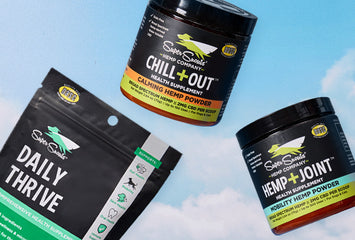
Where Chill + Out earns its place is around the predictable stress spikes — fireworks, storms, vet visits, travel. The chew packs L-tryptophan, chamomile, passionflower, and broad-spectrum hemp (THC stripped to non-detectable), working best 30 to 60 minutes before the event. If hemp isn't for your household, a consistent routine, structured exercise, and desensitization training cover most of what a Beagle needs.
Building a realistic routine
Keep the daily routine small enough to actually maintain. For a healthy adult Beagle, that usually means three products: a daily joint supplement built on green-lipped mussel (effectively non-optional for most breeds as they age), a digestive product matched to the actual pattern (Firm Up! for stool consistency, G.I. Balance for gas, Pumpkin Latte for reflux), and a mushroom blend for skin and allergy support. Calming support is an event-based add-on — fireworks, thunderstorms, travel — rather than a daily item.
Worth stating plainly: this isn't a universal supplement routine. It's the Beagle's, built around joint and mobility, digestive health, skin and coat, and calming support. We didn't include products for categories the breed isn't documented to face an elevated risk in — doing so would inflate the routine without improving outcomes. A tighter supplement plan that reflects the breed's actual risks beats a broader one every time.
The two variables that matter most: dose and fundamentals. On dose — these products are weight-based, and owners err low far more often than high. A Beagle at 20-30 lbs needs the full weight-appropriate serving. On fundamentals — diet, healthy weight, appropriate exercise, and routine vet care are the base; supplements don't replace any of them. Plan on four-to-eight-week effect windows for most ingredients and hold consistent dosing throughout.
The supplement routine that actually works for a Beagle isn't about piling on. It's about pairing the breed's specific risks with the ingredients that address them, and trusting the short list to do the job.