

Generic wellness plans weren't built with the Australian Shepherd in mind. Despite the name, the Australian Shepherd was developed in the American West as a ranch herding dog. They're smart, agile, and wired to work all day — which is both their strength and the source of most behavior problems when under-exercised. That history isn't trivia — it's the reason the breed's modern health profile looks the way it does, and it's where any useful supplement plan has to start.
Most of what gets sold as 'wellness' is noise. The formulas that actually move the needle for a Australian Shepherd are built around a short list of well-supported ingredients at the right doses. Here's that short list, category by category.
Why Australian Shepherds need a tailored supplement plan
Medium breeds like the Australian Shepherd, typically 40-65 lbs at adulthood, sit in a sweet spot for lifespan — but breed-specific risks still show up, and generic formulas miss them. The dogs that thrive into their teens are almost always the ones whose owners planned for the breed's known weaknesses from the start. On top of the physical profile, the Australian Shepherd is a herding breed with elite cognitive demands — a disposition that shapes how stress, exercise load, and recovery all play out day to day.
None of this means the breed is fragile. A Australian Shepherd usually has a 12-15 years lifespan of good years ahead with the right care. What separates supplements that earn their place from the rest is whether they address the breed's specific risks or hedge vaguely across a generic middle.
Everything supplement-related for a Australian Shepherd routes through three main areas: joint and mobility, skin and coat, and calming support.
Joint and mobility: glucosamine, chondroitin, and green-lipped mussel
Joint health matters for Australian Shepherds, even if the breed isn't in the highest risk tier. Hip dysplasia and cruciate injuries are tracked issues. The breed's high drive often pushes joints hard, particularly in herding and agility sports. The most common mistake owners make is waiting for visible stiffness before starting support — by then, the underlying wear has usually been developing for years.
Start with the short list of joint ingredients with real clinical backing: glucosamine, chondroitin sulfate, and MSM (methylsulfonylmethane). Glucosamine supplies the amino sugar cartilage is built from. Chondroitin sulfate gives cartilage its resilience under compression. MSM provides the sulfur that connective tissue depends on. These three form the foundation of any serious canine joint supplement.
If one ingredient covers the most ground for canine joints, it's green-lipped mussel. It provides both glucosamine and chondroitin at biologically useful levels and layers on a unique omega-3 profile — including the less common ETA — that supports a balanced inflammatory response. Peer-reviewed 8-to-12-week trials have measured real joint-comfort gains in supplemented dogs. A Australian Shepherd benefits from an ingredient that addresses several mechanisms at once.
Joint Power takes the single-ingredient approach on purpose: 100% New Zealand green-lipped mussel, cold-processed and lipid-stabilized. Nothing synthetic. No fillers. It's delivered as a food topper so dosing a 65 lbs dog doesn't require a pill-wrestling match.
For a Australian Shepherd, starting joint support by age four or five is a reasonable default. High-drive or working-line dogs benefit from earlier intervention.
Skin and coat: omega-3s, quercetin, and functional mushrooms
The Australian Shepherd's double coat is a real advantage in many climates — and a liability in others. The weatherproof double coat is low-maintenance in health but needs regular brushing — and Aussies are prone to allergies in warmer climates.
The strongest evidence for canine skin support centers on a few ingredients: omega-3 fatty acids (specifically EPA and DHA) that support the skin barrier and calm itch-driving pathways, quercetin (a plant flavonoid often called 'nature's Benadryl') for its role in a normal histamine response, and beta-glucans from functional mushrooms — reishi, turkey tail, chaga, shiitake, lion's mane, maitake, cordyceps — that appear to modulate the overactive immune responses behind most 'seasonal allergies.'
Super Shrooms is built on seven mushroom species plus one inactive ingredient. That's it. It sprinkles on the food bowl and covers two categories in one scoop: skin support plus whole-system immune modulation. For Australian Shepherds whose allergies come and go with the seasons, it's an efficient daily stand-in.
Work upstream before you work downstream. A skin-support supplement can't fix food allergies, environmental triggers, or a flea issue — and those drive the majority of canine skin complaints. When the basics are sorted, omega-3 fatty acids and mushroom-derived beta-glucans are the combination that most reliably turns skin around in a few weeks.
Calming: L-tryptophan, chamomile, and the GABA pathway
Australian Shepherds aren't anxious in the typical sense — they're wired to work. Without that outlet, the wiring turns inward. Mental understimulation creates more stress for Aussies than most breeds — they need jobs, not just exercise.
Calming supplements aren't sedatives. The ingredients with real evidence work by supporting specific pathways in the nervous system. L-tryptophan is the amino-acid precursor to serotonin. L-theanine promotes alpha-wave activity associated with relaxed alertness. Chamomile and passionflower have long-standing traditional use for mild anxiety, with some small-study data in dogs. Hemp-derived compounds have a growing research base for situational stress.
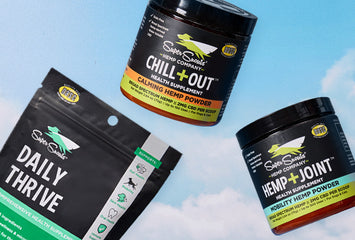
For the triggers you can see coming — fireworks, thunderstorms, vet visits, travel — reach for Chill + Out. The chew combines L-tryptophan, chamomile, passionflower, and broad-spectrum hemp with THC removed to non-detectable levels, dosed 30 to 60 minutes before the event. When hemp isn't the right call, consistent routine, structured exercise, and desensitization training carry Australian Shepherds a long way.
Building a realistic routine
A supplement routine has to be sustainable to do any good. For a healthy adult Australian Shepherd, that usually means holding the line at two products: a daily joint supplement built on green-lipped mussel (effectively non-optional for most breeds as they age) and a mushroom blend for skin and allergy support. Calming support sits on the shelf for predictable trigger events — fireworks, vet visits, travel.
One caveat worth calling out: the plan above is the Australian Shepherd's plan, not a standard multi-breed stack. It maps to joint and mobility, skin and coat, and calming support and stops there because those are the categories where the breed carries real documented risk. Extending the routine beyond those categories adds cost and complication without improving outcomes — and a supplement plan that gets skipped because it's too much isn't a supplement plan at all.
Two rules tend to make or break outcomes. One — dose to the dog's actual weight. A Australian Shepherd at 40-65 lbs needs the full weight-matched serving; underdosing is the most common mistake we see. Two — supplements are additions, not substitutes. They won't fix a mismatched diet, chronic over- or under-feeding, or skipped vet care. Get the fundamentals right first, then layer targeted supplements on top. And give them time — most of the ingredients in this guide take four to eight weeks to show their full effect.
For a Australian Shepherd, the supplement plan that holds up isn't a longer one — it's a better-targeted one. Match documented breed risks to the ingredients with the research to address them. That's the shape a useful routine takes.