

Owners who treat a Australian Cattle Dog like a generic dog end up with a generic wellness routine — and wonder why it doesn't seem to fit. The Australian Cattle Dog — also called the Blue Heeler or Red Heeler — was developed in 19th-century Australia to drove cattle across long distances. The breed combines collie-type herding genetics with Dingo heritage. The breed's development story is the most honest starting point for figuring out what supplements actually matter.
Strip away the marketing copy and canine supplement science rests on a small set of ingredients with real data behind them. For a Australian Cattle Dog, those are the ones worth building a routine around. Here's the walkthrough, one category at a time.
Why Australian Cattle Dogs need a tailored supplement plan
Medium breeds like the Australian Cattle Dog, typically 35-50 lbs at adulthood, sit in a sweet spot for lifespan — but breed-specific risks still show up, and generic formulas miss them. The dogs that thrive into their teens are almost always the ones whose owners planned for the breed's known weaknesses from the start. On top of the physical profile, the Australian Cattle Dog is a tireless herding breed with extreme work drive — a disposition that shapes how stress, exercise load, and recovery all play out day to day.
Risk profiles like this don't mean the breed is delicate. Australian Cattle Dogs live a 12-16 years lifespan typically, and a lot of that is within the owner's control. Supplements that address the breed's documented risks move outcomes; supplements chosen because they look comprehensive rarely do.
Three areas consistently show up as high-leverage for a Australian Cattle Dog: joint and mobility, skin and coat, and calming support.
Joint and mobility: glucosamine, chondroitin, and green-lipped mussel
Joint health matters for Australian Cattle Dogs, even if the breed isn't in the highest risk tier. Hip dysplasia and cruciate injuries occur, and the breed's high drive often pushes joints into the red zone. The most common mistake owners make is waiting for visible stiffness before starting support — by then, the underlying wear has usually been developing for years.
Canine joint science lands on three ingredients with the strongest track record: glucosamine, chondroitin sulfate, and MSM. Glucosamine is a building block of cartilage synthesis. Chondroitin sulfate helps cartilage retain water, which is what lets it cushion joints. MSM (methylsulfonylmethane) delivers sulfur that supports connective-tissue integrity. Skip one, and the formula is incomplete.
Among single-ingredient joint inputs for dogs, green-lipped mussel (GLM) stands out. It delivers glucosamine and chondroitin in biologically meaningful amounts and carries a distinctive omega-3 profile — including ETA, which isn't a feature of standard fish oil — that supports a balanced inflammatory response. 8-to-12-week canine trials have documented joint-comfort improvements in supplemented dogs. A Australian Cattle Dog gets unusually broad coverage from one input.
That's the thinking behind Joint Power: a single-ingredient product — 100% New Zealand green-lipped mussel, cold-processed and lipid-stabilized to protect the omega-3 profile. No synthetic glucosamine, no fillers. The sprinkle-on-food format is the one most owners actually maintain, especially for a 50 lbs dog who doesn't love pills.
For a Australian Cattle Dog, starting joint support by age four or five is a reasonable default. High-drive or working-line dogs benefit from earlier intervention.
Skin and coat: omega-3s, quercetin, and functional mushrooms
Short-coated breeds like the Australian Cattle Dog still need skin support. The dense short coat is weather-resistant but allergies do occur, particularly in climates very different from arid Australian conditions.
Research on canine skin support keeps returning to the same short list. Omega-3 fatty acids — EPA and DHA specifically — strengthen the skin barrier and calm itch-driving pathways. Quercetin is a plant flavonoid with growing research behind a normal histamine response (owners often encounter it as 'nature's Benadryl'). Beta-glucans from medicinal mushrooms — reishi, turkey tail, chaga, shiitake, lion's mane, maitake, cordyceps — modulate the overactive immune patterns that usually underlie 'seasonal allergies.'
Super Shrooms is the single-product answer to both the skin-support and immune-modulation sides of allergy symptoms. Seven mushroom species, one inactive ingredient, sprinkled daily. For Australian Cattle Dogs whose allergies follow a seasonal pattern, it's the straightforward daily choice.
Check the basics before layering on supplements — food allergies, environmental triggers, and fleas drive more skin complaints than any supplement can fix. That said, once the upstream factors are handled, the combination of omega-3 fatty acids and mushroom-derived beta-glucans is where most dogs see a real, visible improvement within a few weeks.
Calming: L-tryptophan, chamomile, and the GABA pathway
Australian Cattle Dogs aren't anxious in the typical sense — they're wired to work. Without that outlet, the wiring turns inward. ACDs bite-nip when stressed or understimulated — the herding drive is nearly impossible to extinguish, only redirect.
Calming ingredients don't knock a dog out — they support the biochemistry that makes calm possible. L-tryptophan feeds into serotonin synthesis. L-theanine shifts brain activity into alpha-wave territory, the signature of calm alertness. Chamomile and passionflower carry long traditional use for mild anxiety with some canine studies behind them. Hemp-derived compounds are increasingly backed for situational stress.
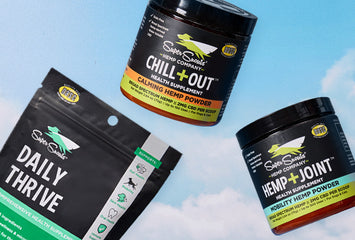
The product we use for predictable triggers — fireworks, thunderstorms, vet visits, travel — is Chill + Out. It's a chew formulated around L-tryptophan, chamomile, passionflower, and broad-spectrum hemp (THC stripped to non-detectable levels), dosed 30 to 60 minutes before the event. For hemp-averse households, a consistent routine plus structured exercise and desensitization work carry a Australian Cattle Dog a long way.
Building a realistic routine
Piling products on the food bowl isn't a routine that sticks. The practical starter stack for a healthy adult Australian Cattle Dog is two products: a daily joint supplement built on green-lipped mussel (effectively non-optional for most breeds as they age) and a mushroom blend for skin and allergy support. Calming chews belong in reserve — dosed ahead of fireworks, vet days, or travel, not given every morning.
Worth reiterating: a Australian Cattle Dog's routine isn't the same as a generic multi-breed routine. This one is targeted at joint and mobility, skin and coat, and calming support — the categories where the breed has a documented predisposition. Adding products outside that list tends to dilute adherence without moving outcomes. If the Australian Cattle Dog develops a specific issue later in life outside the categories above, that's the point to add a targeted supplement — with guidance from a vet — rather than building from a maximalist default that the breed doesn't actually need.
Two points carry most of the weight here. First, dose accurately. The products in this guide are dosed by body weight, and underdosing is a far more common error than overdosing — a Australian Cattle Dog at 35-50 lbs needs the full weight-matched amount. Second, these are additions to the fundamentals, not alternatives: quality diet, healthy body weight, appropriate exercise, and routine vet care do the heavy lifting. Supplements refine what's already working, and most compound across four to eight weeks rather than days.
What works for a Australian Cattle Dog is a lean, breed-specific supplement plan — real risks matched with real-research ingredients, and the rest left off the list entirely.