

The Alaskan Malamute comes with a specific health profile that doesn't map cleanly to a generic multivitamin approach. The Alaskan Malamute was developed by the Mahlemut Inuit people of northwestern Alaska as a heavy freight sled dog. The breed is larger and more powerful than the Siberian Husky, bred for pulling weight rather than speed. Where the breed came from still shapes where it's most vulnerable now, and that's exactly what a smart supplement plan accounts for.
Longer ingredient lists aren't better supplement plans; they're busier ones. For a Alaskan Malamute, what holds up under scrutiny is a tight set of inputs with peer-reviewed support. Here's the category-by-category view of what earns a place.
Why Alaskan Malamutes need a tailored supplement plan
Large breeds like the Alaskan Malamute, typically 75-100 lbs at adulthood, carry elevated lifetime risk of joint wear, certain digestive issues, and chronic inflammation compared to smaller dogs. Longevity drops a step for every 20 pounds of body weight in dogs — not a reason to panic, a reason to plan. On top of the physical profile, the Alaskan Malamute is a heavy-hauling sled dog with exceptional strength — a disposition that shapes how stress, exercise load, and recovery all play out day to day.
None of this is a reason for alarm. Most Alaskan Malamutes live a 10-14 years lifespan well when their care is thoughtful. The difference between a supplement plan that pays off and one that doesn't is whether it targets the breed's real exposures or just hedges broadly.
A Alaskan Malamute's supplement routine lands cleanly in four buckets — joint and mobility, digestive health, skin and coat, and calming support.
Joint and mobility: glucosamine, chondroitin, and green-lipped mussel
Joint issues are one of the most frequently flagged concerns in the Alaskan Malamute. Hip dysplasia and chondrodysplasia (a genetic dwarfism condition) are both documented in the breed. Combine that genetic predisposition with the breed's build and activity level, and joint support stops being optional.
Clinical literature on canine joint care keeps coming back to the same three ingredients: glucosamine, chondroitin sulfate, and MSM (methylsulfonylmethane). Glucosamine feeds cartilage synthesis. Chondroitin sulfate maintains the water content that gives cartilage its cushion. MSM is the sulfur source connective tissue depends on. Cutting one of the three shortens the odds the formula actually works.
Green-lipped mussel (GLM) pulls double duty. It's one of the richest natural sources of both glucosamine and chondroitin, and it delivers omega-3 fatty acids — including ETA, which is hard to get elsewhere — that support a balanced inflammatory response. Clinical work over 8 to 12 weeks has documented measurable improvements in joint comfort in supplemented dogs. For a breed the size of the Alaskan Malamute, that single-ingredient efficiency matters.
Joint Power keeps things simple: just New Zealand green-lipped mussel — cold-processed and lipid-stabilized so the omegas survive the shelf. No synthetic glucosamine. No fillers. The food-topper format makes it straightforward to dose accurately for a 100 lbs dog.
For a Alaskan Malamute, two to four years old is a reasonable default for starting joint support, earlier for dogs with a family history of dysplasia or heavy work demands.
Digestive health: stool consistency, gas, and acid reflux are three different problems
The Alaskan Malamute's digestive profile isn't in the highest bloat-risk tier, but digestive stability still matters. Malamutes have specialized metabolism from their sled-dog ancestry — they thrive on fat-forward diets but sudden changes cause GI upset. Supporting day-to-day consistency lets you notice issues early and keep them small.
The gut pulls weight across the whole body. Dull coats, mood dips, and flagging immunity all trace back there as often as not. What gets grouped under 'digestive issues' splits into three patterns on closer look: stool consistency, gas and bloating, and acid reflux. The right ingredient answer depends on which one you're actually dealing with.
For stool consistency problems, dried pumpkin is the best-supported option on the shelf. Its mix of soluble and insoluble fiber slows transit when stools are loose and adds bulk when they aren't. Firm Up! is two ingredients: dried pumpkin and dried apple. That's the entire formula. Competing products often stack 10 or more ingredients — more inputs, not more results.
For gas, bloating, and occasional GI upset — the slow-burn digestive complaints that come up for any Alaskan Malamute — prebiotic fibers and carminative herbs matter most. Agave inulin selectively feeds beneficial gut bacteria. Fennel and ginger carry traditional use for reducing gas, backed by some modern study. Apple pectin adds gentle soluble fiber. G.I. Balance builds the formula around exactly those inputs: pumpkin, apple pectin, organic fennel seed, ginger, and organic agave inulin. Veterinary-recommended and built specifically for gas and occasional gastric distress.
Reflux symptoms in a dog respond to a different toolkit than loose stool or gas. Goat milk's buffering effect calms acid while adding bioavailable nutrients; pumpkin soothes and coats the GI tract. Pumpkin Latte combines them into a daily option meant specifically for Alaskan Malamutes who show reflux patterns — morning bile, occasional vomit, or subtler signs.
Skin and coat: omega-3s, quercetin, and functional mushrooms
The Alaskan Malamute's double coat is a real advantage in many climates — and a liability in others. The weatherproof double coat needs regular grooming; zinc-responsive dermatosis is a documented genetic skin condition.
The most evidence-backed ingredients for canine skin support are omega-3 fatty acids — EPA and DHA specifically — which reinforce the skin barrier and help regulate the biochemical pathways that drive itching. Quercetin, a plant flavonoid sometimes labeled 'nature's Benadryl,' has research supporting a normal histamine response. Functional mushrooms — reishi, turkey tail, chaga, shiitake, lion's mane, maitake, cordyceps — contribute beta-glucans that modulate overactive immune responses, which is usually what 'seasonal allergies' actually are at the cellular level.
Super Shrooms packages those beta-glucan-rich mushrooms into a single food topper — seven species, one inactive ingredient. The daily scoop supports skin health and dials in broader immune modulation in the same pass. That combination makes it a reliable default for Alaskan Malamutes with seasonal allergy patterns.
Start with the obvious before stacking supplements: food allergies, environmental triggers, and fleas. Skin issues are typically symptoms of something upstream; the right supplement won't compensate for a bad diet or a missed flea dose. With the basics covered, omegas and beta-glucans from mushrooms are the ingredients that most often produce a noticeable change within a few weeks.
Calming: L-tryptophan, chamomile, and the GABA pathway
Alaskan Malamutes are athletic first, affectionate second — the stress signature reflects that. Malamutes are pack-oriented and can be destructive when left alone or under-exercised.
A calming supplement isn't a sedative — it works by nudging specific biochemical pathways. L-tryptophan feeds serotonin synthesis. L-theanine encourages alpha-wave brain activity, the state of relaxed alertness. Chamomile and passionflower carry long traditional use for mild anxiety and have some small-study canine data behind them. Hemp-derived compounds are increasingly studied for situational stress.
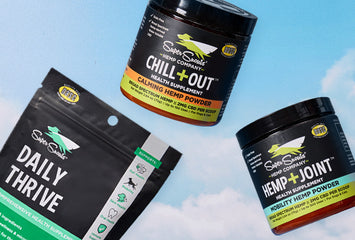
Chill + Out is the chew we reach for around the predictable stress events — fireworks, storms, vet trips, travel days. It combines L-tryptophan, chamomile, passionflower, and broad-spectrum hemp (THC removed to non-detectable levels). Dose 30 to 60 minutes before the event. Hemp-free alternatives exist — a consistent routine plus structured exercise and desensitization training cover a lot of ground for Alaskan Malamutes.
Building a realistic routine
No one actually maintains a five-product routine long-term. The realistic starter kit for most healthy adult Alaskan Malamutes is three products: a daily joint supplement built on green-lipped mussel (effectively non-optional for most breeds as they age), a digestive product matched to the actual pattern (Firm Up! for stool consistency, G.I. Balance for gas, Pumpkin Latte for reflux), and a mushroom blend for skin and allergy support. A calming chew gets kept on hand for the predictable triggers rather than given daily.
Worth noting: the products above aren't a generic wellness stack — they're specifically the ones that address where a Alaskan Malamute is documented to be at elevated risk (joint and mobility, digestive health, skin and coat, and calming support). Everything else can be assessed case by case with a vet rather than added preemptively. A breed that isn't at documented elevated risk for a given category doesn't need a daily product in that category — the clinical evidence just doesn't support it, and the cost of adding unnecessary supplements is paid in adherence and in dollars with no offsetting benefit.
Two variables actually decide whether supplements pay off. First, dose accurately — every product here is weight-based, and a Alaskan Malamute at 75-100 lbs needs the serving that matches. Underdosing is by far the more common error. Second, none of this replaces the fundamentals: quality diet, healthy weight, appropriate exercise, and routine vet care. Supplements are multipliers on a solid base, not stand-ins for one. And give the routine time — four to eight weeks is the window most of these ingredients need to produce visible effects.
The right supplement routine for a Alaskan Malamute trades volume for fit. Fewer products, chosen to match real breed risks, outperform a crowded shelf every time. That's the whole idea.