

A single-mushroom supplement gives you one species and one compound profile. A blend gives you several, on the reasoning that different mushrooms carry different beta-glucan structures and secondary compounds. Neither approach is automatically stronger. What separates a good product from a weak one is whether it uses fruiting bodies, whether beta-glucans are measured, and whether the amount per serving is disclosed at all.
What are beta-glucans, and why do they dominate the conversation?
Beta-glucans are polysaccharides found in fungal cell walls, and they are the compounds most of the research on medicinal mushrooms centers on. Their structure varies by species, with different branching patterns at the molecular level, which is the basis for the argument that variety has value.
They are not the only compounds present. Triterpenes, ergosterol, and various peptides also appear, in proportions that differ across species. But beta-glucans are the measurable, comparable number, which makes them the practical yardstick when you are standing in an aisle comparing two bags.
The honest framing here is nutritional. Mushrooms are a food-derived source of these compounds, and that is the appropriate way to think about them.
Fruiting body or mycelium: does it matter?
Substantially, and this is the single largest quality divide in the category. The fruiting body is the mushroom you would recognize. Mycelium is the root-like network, and in commercial production it is typically grown on grain and harvested together with that grain.
The consequence is dilution. A mycelium-on-grain product can be largely starch by weight, which drags down beta-glucan content while still qualifying as a mushroom ingredient on the label. Independent analyses have repeatedly found meaningful gaps between grain-substrate products and fruiting body extracts on measured beta-glucan.
Watch for the tell: if an ingredient list mentions "mycelial biomass" or names a grain, the substrate is in the bag. That is not fraud, but it changes what you are paying for per gram.
Which species show up most often, and what distinguishes them?
Five species account for most of what you will encounter.
- Reishi. Notable for triterpene content alongside beta-glucans; bitter, and used traditionally for general support.
- Turkey tail. Among the most studied, with a well-characterized polysaccharide profile.
- Shiitake. Familiar as a culinary mushroom, with lentinan among its documented polysaccharides.
- Maitake. Carries a distinct beta-glucan fraction and is palatable to most dogs.
- Cordyceps. Frequently included for energy-related traditional use; check whether the product uses cultivated material.
Each brings a somewhat different molecular profile. Whether that difference translates into a difference your dog experiences is a fair question, and one the current evidence base cannot answer with precision.
Blend or single species: how do they actually compare?
The attribution column deserves emphasis. If you feed a six-species blend and something improves, you have learned that the blend helped, not which part of it did. For most owners that is an acceptable trade. For anyone running a careful trial, it is not.
What does a good mushroom label look like?
It names species, specifies the part used, and reports measured beta-glucans. Anything missing one of those three is asking you to take it on faith.
Run this check:
- Latin binomial for each species, not just a common name.
- "Fruiting body" stated explicitly.
- Beta-glucan percentage, measured, rather than a total polysaccharide figure.
- Milligrams per serving for each species, or at minimum for the blend total.
- Extraction method, if the product is an extract, since hot water and alcohol pull different compounds.
Polysaccharide totals are the number to be skeptical of, because starch is a polysaccharide. A product reporting 40 percent polysaccharides and 8 percent beta-glucans has told you where the other 32 percent came from.
Where does a fruiting-body blend fit?
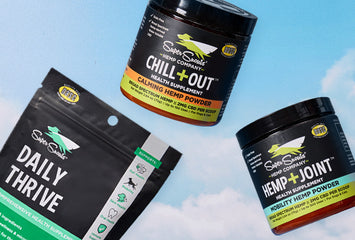
It fits owners who want broad daily coverage without assembling four separate containers. Super Shrooms is built from mushroom fruiting bodies as a daily source of naturally occurring beta-glucans, which is the straightforward case for the blend approach: multiple species, one scoop, one thing to remember in the morning.
The counterargument stands, though. If your veterinarian has pointed you toward one specific species for a specific reason, a concentrated single-species product delivers more of it per serving than any blend can.
Mushrooms are food, but immune-modulating ingredients deserve a conversation with your dog's clinician, particularly when there is an autoimmune diagnosis or an immunosuppressive medication in the picture.
More reading: our overview of beta-glucans and how they are measured and our guide to evaluating supplement labels. Study abstracts on fungal polysaccharides are searchable through PubMed.
Frequently asked questions
Are grocery store mushrooms as good as a supplement?
Culinary mushrooms do contain beta-glucans, but at much lower concentrations than a dried or extracted product, and cell walls need cooking to break down before much becomes available. Feeding cooked plain mushrooms is not harmful for most dogs, though matching a supplement's content would require an impractical quantity of produce.
Can dogs eat wild mushrooms?
No, and this is one of the few places to be absolutely rigid. Toxic species closely resemble edible ones, identification requires genuine expertise, and some wild mushrooms cause severe harm rapidly. If your dog eats an unidentified mushroom in the yard, contact your veterinarian or an animal poison control line immediately rather than waiting for symptoms.
How long does a mushroom supplement take to show anything?
Expect six to twelve weeks before drawing conclusions. Effects tied to immune function are slower and subtler than digestive changes, and they rarely announce themselves dramatically. Owners looking for a visible difference inside two weeks are generally measuring the wrong timescale for this category.
Is a higher milligram number better?
Not on its own. Two thousand milligrams of grain-grown mycelium can carry fewer beta-glucans than five hundred milligrams of a concentrated fruiting body extract. Compare measured beta-glucan content per serving rather than total powder weight, since weight tells you how much material is in the scoop, not how much of what you want.
Do mushroom supplements make dogs gassy?
Some dogs do get mild gas during the first week or two, since the polysaccharides are fermentable and the gut microbiome takes time to adapt. Starting at a partial serving and building up over a week usually prevents it. Gas that worsens rather than fading warrants a pause and a phone call.