
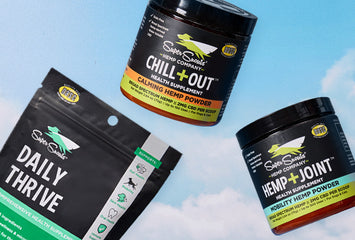

Most dog supplements hold their labeled potency for roughly 18 to 24 months unopened, and something closer to 60 to 90 days once the seal breaks. Heat, humidity, and light shorten every one of those numbers. Keep powders sealed in a cool, dark cabinet, keep live cultures away from the stove and the car, and read the printed date as a promise about unopened product only.
What actually degrades in a supplement?
Different ingredients fail in different ways, which is why one storage rule cannot cover a whole shelf. Oils oxidize. Live bacteria die off. Botanical actives break down under ultraviolet light. Powders absorb moisture from the air and cake into something you cannot scoop.
Oxidation is the most common culprit in fish oils and fat-soluble ingredients, and it announces itself with a paint-like smell. Probiotic decline is quieter, because a dead culture looks identical to a live one. Nothing about the appearance of the powder tells you how many organisms survived the summer.
Moisture deserves special mention. Water is the solvent that lets every other degradation reaction proceed faster, so a humid cabinet accelerates problems that heat alone would take months to cause.
How long does an opened container really last?
Plan on two to three months for most opened powders, and check the specific label for anything with live cultures or oils. The printed expiration date assumes an intact seal, a controlled warehouse, and no daily exposure to kitchen air.
Every time you open a container you swap dry headspace for room air carrying humidity and oxygen. Do that once a day for ninety days and the interior environment looks nothing like it did at the factory. Smaller containers you finish quickly beat bulk bags you keep for a year, even when the bulk math looks better on paper.
Does heat matter more than time?
Usually, yes. Chemical degradation roughly doubles in rate for every 10 degrees Celsius of temperature increase, so a supplement stored at 30C ages several times faster than one at 20C.
That rule explains most real-world potency losses. A bag left in a car in July can reach 60C in under an hour. A cabinet directly above the range gets a heat pulse every time dinner cooks. Neither situation shows up on the expiration date, and both quietly shorten the useful life of whatever is inside.
Where's the worst place in your house to keep supplements?
The convenient spots are usually the bad ones. Ranked from worst upward:
- The car. Extreme swings, direct sun, no ventilation. Nothing survives a glovebox summer intact.
- Above or beside the stove. Repeated heat cycling plus steam.
- The windowsill. Ultraviolet light degrades botanical and vitamin actives directly.
- The bathroom. Shower humidity is the problem here, not temperature.
- On top of the refrigerator. The compressor exhausts warm air upward all day long.
A plain interior cabinet on an inside wall, away from appliances, beats every one of those.
Do probiotics need refrigeration?
Some do, and the label is the only reliable guide. Certain strains are shelf-stable by design, often spore-forming ones that tolerate ambient storage well. Others are freeze-dried cultures that lose viable counts steadily at room temperature.
When a manufacturer overages a product, it packs in more organisms than the label claims so the count still meets the guarantee at the end of shelf life. That practice is normal and useful, but it assumes storage within the stated range. Push past it and the buffer disappears. Research on probiotic viability, indexed through PubMed, consistently identifies temperature as the dominant variable in survival over time.
How do you tell a supplement has gone off?
Trust your nose and your eyes before you trust the date. Watch for:
- A sour, sharp, or crayon-like smell where there was none before
- Clumping that resists a spoon, which means moisture got in
- Color shift, especially browning in a light-colored powder
- Oil separating or pooling in a soft chew
- Sudden refusal of something your dog used to eat happily
That last one is worth taking seriously. Dogs detect rancidity long before people do. If a container smells sour, has hardened into a brick, or your dog reacts poorly after a scoop, stop feeding it and phone your veterinary clinic instead of guessing whether it is still fine.
Pantry, fridge, or freezer?
Each has a place, and the wrong choice can cause the exact problem you were trying to avoid.
The condensation issue trips people up. Pulling a cold jar of powder into a humid kitchen invites water to condense on the interior surfaces the moment the lid comes off. If you refrigerate something, portion it and let it warm up closed.
How should you store a pumpkin powder?
Treat it like flour, not like produce. Dehydrated pumpkin has very low water activity, which is exactly what makes it stable at room temperature for a long stretch, and that stability collapses once humidity gets in.
So keep the container closed between uses, use a dry scoop every single time, and never shake the powder over a steaming bowl. Steam is water, and water is what you paid to have removed. Pumpkin Latte is a pumpkin-based daily blend, and like any dried pumpkin product it belongs in a sealed container in a cabinet rather than on the counter beside the kettle.
Worth reading alongside this: our primer on pumpkin as a fiber source and our explainer on what CFU counts mean. Veterinary nutrition resources from Cornell make a good backstop when a label leaves you uncertain.
Frequently asked questions
Is a supplement dangerous after the expiration date?
Usually not dangerous, just weaker. The main exception is anything containing oils, which can turn rancid and cause real digestive upset. For dried powders and capsules, an expired product typically delivers less active compound than the label claims rather than becoming harmful, though a rancid smell always means the container goes in the trash.
Can I decant supplements into a nicer container?
You can, with two conditions: the new container must seal properly, and you must write the lot number and expiration date on it. Losing that information means losing your ability to report a problem or check a certificate of analysis later. Opaque containers beat clear glass jars for anything light-sensitive.
Does the little silica packet matter?
More than most people think. That desiccant absorbs ambient moisture inside the headspace and does continuous work every day the container sits closed. Leave it in the bag until the product is finished. Tossing it on day one measurably shortens how long a hygroscopic powder stays scoopable.
Should I buy the biggest size to save money?
Only if your dog will finish it within the opened shelf life. A 90-day supply for a Great Dane is a nine-month supply for a Chihuahua, and the Chihuahua's owner spends the back half feeding a degraded product. Match container size to actual consumption rate rather than to the price-per-ounce chart.
How do I travel with supplements?
Portion what you need into a small sealed container and keep it in the cabin or a cooler rather than a hot trunk. Over a week-long trip, temperature exposure matters far more than which container you chose. Pre-measuring daily doses also removes the temptation to eyeball a scoop in an unfamiliar kitchen.