

Shetland Sheepdog owners get the most from supplements by focusing on three breed-documented fronts: skin and coat health under that dramatic double coat, a nervous system wired for vigilance (and sometimes overwired for thunderstorms), and a digestive tract that registers every schedule change in the household. Shelties are watchers and worriers by design — supporting them means calming the inputs as much as feeding the outputs.
Meet the Sheltie: a big herding brain in a 20-pound package
The Shetland Sheepdog stands 13 to 16 inches and usually weighs 15 to 25 pounds — a true small breed carrying the instincts of a full-size herder. The AKC's Sheltie profile ranks them among the most trainable dogs alive: obedient, quick, intensely attached to their people, and enthusiastic about announcing visitors, squirrels, and changes in barometric pressure. Expect 12 to 14 years, a profuse double coat that sheds seasonally in earnest, and a dog that notices everything.
That noticing is the key to this whole guide. A breed selected to monitor sheep on windswept islands monitors your living room with the same intensity — and sensitive dogs tend to carry stress in their skin and their stomachs.
What does that double coat need from the inside?
A Sheltie in full coat is mostly hair by volume, and healthy hair is metabolically expensive — skin and coat consume a meaningful share of a dog's daily protein and fatty acid intake. The foundation is a complete, balanced diet; no topper rescues a poor base food. From there, we look at immune-supportive ingredients, because canine skin is where immune imbalance most often surfaces first, whether that's seasonal itch or dull, brittle coat.
The breed also carries a specific dermatologic condition worth knowing by name: dermatomyositis, an inherited inflammatory disease of skin and muscle documented in Shelties and Collies. Patchy hair loss on the face, ears, or tail tip in a young Sheltie is a see-your-vet-now finding, not a supplement situation — diagnosis requires a veterinary workup, sometimes including biopsy. Shelties are additionally prone to hypothyroidism, which frequently shows up as coat thinning and weight gain; VCA's hypothyroidism overview is a good read before your senior dog's next blood panel.
For everyday inside-out coat support in a healthy Sheltie, we reach for mushroom beta-glucans. Super Shrooms delivers seven organic mushrooms in one powder — turkey tail, reishi, maitake, and company — chosen for polysaccharides studied in immune modulation. One small scoop suits a small dog's meal, and coat season is exactly when we'd run it.
Can you supplement a storm-watcher's nerves?
Shelties are famously sound-sensitive. Thunder, fireworks, the smoke alarm's low-battery chirp — many members of this breed react with pacing, trembling, or a full herding-dog alarm concert. Behavioral tools come first and always: safe retreat spaces, sound desensitization done gradually, and predictable routines, which matter enormously to this breed. For dogs whose anxiety is severe, a veterinarian or veterinary behaviorist should lead — real pharmaceutical options exist, and no chew replaces them.
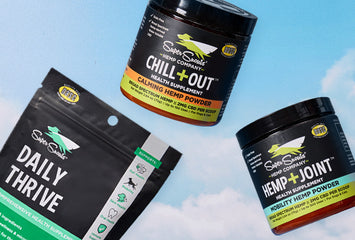
Where ingredients can help around the edges: lion's mane mushroom has drawn research interest for nervous-system and cognitive support, which is why we built Lion's Roar around it — a fit for the aging Sheltie whose vigilance is tipping into restlessness or nighttime pacing. For situational stress like storm season, our Chill + Out calming chews combine hemp with calming botanicals. Start any calming product before the stressful event, not during it, and clear it with your vet first — particularly for a breed where drug sensitivities are on the record (more on that below).
Why do Shelties get an 'ask your vet first' flag on medications?
Many Shelties carry the MDR1 gene mutation, which changes how the body handles certain common drugs — some antiparasitics, anti-diarrheals, and sedatives among them. A cheek-swab genetic test tells you your dog's status, and it's information worth having on file before a medication is ever needed. We flag this in a supplement article for one reason: it's the clearest possible argument for running every product, ours included, past your veterinarian. Resources like the Cornell Riney Canine Health Center cover breed-linked genetics in plain language if you want to go deeper.
Settling the Sheltie stomach
Sensitive dogs are sensitive at both ends of the leash and both ends of the dog. Sheltie owners commonly report soft stool during houseguests, travel, or schedule shake-ups — stress and the gut talk to each other constantly through the gut-brain axis. Our fix is unheroic and reliable: soluble fiber. Firm Up!, our pumpkin-and-apple-pectin powder, helps the colon manage water so stress-week stool stays formed. Small dogs need small doses — follow the weight chart on the label. Loose stool that outlasts the stressor by more than a couple of days, or any blood, moves the question from our jar to your vet's exam room.
A sensible Sheltie stack
- Daily base: quality complete diet; Firm Up! with a meal during travel, boarding, or household upheaval.
- Coat seasons (spring/fall): Super Shrooms for immune and skin support while the undercoat turns over.
- Storm and fireworks season: vet-approved calming support, started ahead of the noise, layered on top of behavior work.
- Seniors: consider lion's mane for cognitive support around age nine, and ask your vet about thyroid screening at annual bloodwork.
Two products running at once is a normal ceiling for a dog this size. Add slowly, watch the dog, and keep your veterinarian in the loop — with MDR1 in the breed, that habit isn't optional politeness, it's good medicine.
Sheltie FAQ
What supplement helps most with Sheltie shedding?
Nothing stops a double coat from blowing — that's healthy biology. What you can support is the skin underneath and the quality of incoming coat: complete nutrition, omega-3 intake, immune-supportive mushroom polysaccharides, and diligent brushing. Sudden or patchy hair loss is different from shedding and warrants a veterinary visit.
Is it safe to give my Sheltie calming chews for fireworks?
Often yes, but this is the breed to double-check. Because many Shelties carry the MDR1 mutation, confirm any calming ingredient — including hemp — with your veterinarian, ideally after genetic testing. Dose ahead of the event and pair it with a quiet den space.
My Sheltie gets soft stool every time we travel. Normal?
Common, thanks to the gut-brain connection in a sensitive breed — but manageable. Pre-load fiber support a day or two before travel, keep the diet unchanged on the road, and pack their normal food. If stool doesn't firm up within a few days of arriving home, check in with your vet.
Do Shelties need joint supplements?
It's not our first-priority category for the breed — Shelties are structurally sound little dogs. Agility competitors putting in serious jump mileage, and seniors slowing on stairs, are reasonable candidates for green-lipped mussel; your veterinarian can assess whether joints or something else (like hypothyroid weight gain) explains a slowdown.
Where this leaves you
A Sheltie gives you its full attention for a dozen years or more — the job is managing what all that attention costs. Feed the coat from within, buffer the stomach through disruptions, take storm stress seriously, and get the MDR1 test so every future medication decision starts from knowledge. We'll keep the formulas short and honest; your veterinarian gets the final word on every one of them.