
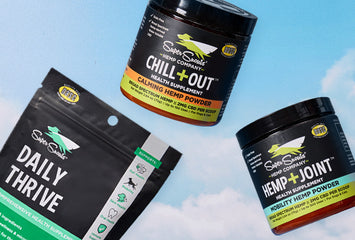

Format changes three things that matter: how precisely you can dose, how likely your dog is to accept it, and how much filler comes along with the active ingredient. Powders win on dosing precision and ingredient density. Chews win on convenience and compliance. Liquids win for small dogs and dogs who will not eat anything solid with an odd texture. The right choice depends more on your dog and your routine than on the ingredient.
Why does format matter at all?
Because a supplement your dog does not take is worth nothing, and a dose you cannot measure accurately is worth less than you think. Those two failure modes account for most disappointing outcomes, well ahead of the ingredient itself being ineffective.
There is also a formulation reality. A chew has to hold together, taste good, and sit on a shelf, which means binders, humectants, and flavoring occupy space that could hold active ingredient. A powder has no such constraint. That difference shows up directly in how much of the thing you are paying for actually arrives in the bowl.
What are powders best at?
Density and flexibility. Because a powder does not need structural ingredients, a scoop can be mostly or entirely the active material. That matters when the effective amount of an ingredient is measured in grams rather than milligrams — fiber sources are the obvious case, since you cannot fit a meaningful fiber dose into a treat-sized chew.
Powders also let you titrate. Starting at a quarter dose and working up over a week is trivial with a scoop and impossible with a pre-formed chew you would have to cut. And they disappear into wet food, which helps with dogs who detect and reject anything solid.
The trade-offs are real: powders require measuring, they can clump in humid kitchens, and they are the least convenient option when someone else is feeding your dog.
Firm Up is a powder for exactly the density reason — a concentrated pumpkin powder delivers a soluble fiber dose that no chew format could physically hold.
What are chews best at?
Compliance, which is not a small thing. A supplement given reliably at a moderate dose beats one given sporadically at an ideal dose. Chews get taken because the dog thinks she is getting a treat, and because nobody has to measure anything at 6 a.m.
They also travel well, survive being handed to a dog sitter with minimal instruction, and avoid the powder-left-in-the-bowl problem entirely. For households where more than one person feeds the dog, this often decides it.
The limits: dose granularity is coarse, since you are working in whole or half chews rather than a continuous range. Active ingredient per unit is lower. Palatants and binders add calories that count for a dog on a weight plan. And a dog who decides she dislikes the flavor leaves you with an expensive bag and no alternative.
What are liquids best at?
Small dogs and precise micro-dosing. A syringe measures in tenths of a milliliter, which no scoop can match, and for a six-pound dog that precision is the difference between a correct dose and a rough approximation.
Liquids also absorb without needing to dissolve first, which can matter for a dog with compromised digestion, and they mix into water-based food easily. Oils in particular only exist in liquid or capsule form for obvious reasons.
Downsides: shorter shelf life once opened, oxidation risk for oils, refrigeration requirements for some products, and mess. A dropper bottle in a car or a suitcase is a gamble.
How do the three compare directly?
How do you get the dose right?
Weigh it if you can. Kitchen scales that read to the gram cost less than a month of most supplements, and volume measures are surprisingly imprecise — a packed scoop and a loose one can differ by a third depending on how the powder has settled.
For liquids, use a syringe rather than the cap. For chews, do not split them by eye if the dose is weight-dependent. A veterinary technician can show you exactly how much of a powder or liquid your dog should receive, which beats estimating from a scoop that vanished into the bag three weeks ago. Front desks generally accommodate that request without an appointment.
Which format suits which dog?
Some rough guidance:
- Under 15 pounds — liquid or powder, because chew dosing granularity is too coarse at that size.
- Fiber or gram-scale ingredients — powder, no real alternative.
- Multiple people feeding the dog — chew, for the consistency it buys.
- Dog on a weight management plan — powder, to avoid treat calories.
- Dog who inspects and rejects doctored food — chew, or a liquid mixed thoroughly into wet food.
- Frequent travel or boarding — chew, for portability and simple handover instructions.
If your dog refuses whatever you land on, our guide to getting a reluctant dog to take a supplement works through the options before you give up on a format entirely.
Does format affect how well an ingredient works?
Sometimes, though less than marketing suggests. Compounds that degrade with heat can be affected by chew manufacturing, and live probiotic organisms have real viability considerations across formats and storage conditions. For most straightforward ingredients — fibers, oils, minerals — the format matters far less than the amount actually consumed.
Where it genuinely matters, a reputable manufacturer will address stability on the label or in their published information. Our piece on what to look for on a supplement panel covers how to check.
FAQ
Is a powder always more cost effective than a chew?
Per gram of active ingredient, usually yes, sometimes substantially. But cost per gram is the wrong metric if the powder ends up half-eaten in the bottom of a bowl. Compare cost per dose actually consumed, which for a picky dog can flip the comparison entirely in favor of the chew.
Can I turn a chew into a powder by crushing it?
You can, and it works for dogs who dislike the texture, though you lose the palatant's effect once it is dispersed. Crush it fully and mix into wet food rather than sprinkling it on kibble. Check first whether the product has any coating designed to survive the stomach, since crushing defeats that.
Do liquids really absorb faster?
Slightly, because they skip the dissolution step. Whether that speed matters depends entirely on the ingredient — for anything measured in weeks of accumulation, a difference of twenty minutes in absorption is irrelevant. It matters more for dogs with digestive conditions that impair breaking down solids.
How should I store each format?
Powders need dry storage with the container sealed; humidity causes clumping and can affect stability. Chews do best in a cool cupboard rather than a sunny counter. Liquids often need refrigeration after opening and should be used within the window printed on the label, since oils oxidize once air gets in.
My dog takes the chew but I want the higher dose from a powder. Can I use both?
Only if they are different ingredients. Doubling up on the same active ingredient across two formats is how accidental over-dosing happens, particularly with anything the body stores. Pick one source per ingredient and adjust the amount within that product rather than layering formats.