
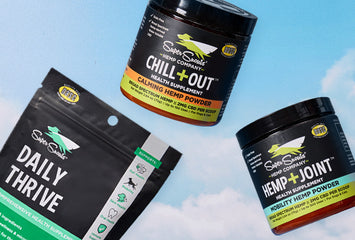

Feeding multiple dogs different diets is a logistics problem, not a nutrition problem. Separate the dogs physically at mealtime, lift the bowls after fifteen minutes, and treat each dog's food the way you'd treat a prescription. The hard part is never picking the diets. It's keeping the fast eater out of the slow eater's bowl, which is what quietly undoes every decision you made.
Can dogs in the same house genuinely eat different food?
Yes, and plenty of households manage it for years. What makes it work is a routine that doesn't depend on anyone paying attention.
Systems relying on supervision fail on the night you're late, or sick, or handing feeding duty to a house sitter. Build the setup so the wrong dog physically cannot reach the wrong bowl, and the plan survives contact with real life.
Before you split one household onto two diets, run the plan past your veterinarian — particularly if one dog eats a therapeutic food, where a few stolen mouthfuls a day genuinely changes the clinical picture.
What's the simplest separation setup that actually holds?
Closed doors. Not gates, not distance, not "they're fine, they don't bother each other."
The arrangements that hold up best, roughly in order:
- Separate rooms with the door shut. Each dog eats alone; doors open once both bowls are empty.
- Crates. Excellent if crates are already a neutral, positive space. Feed inside, latch, release afterward.
- Baby gate with a solid panel. Fine for dogs who don't guard through barriers.
- Opposite ends of a large room, one person per dog. Only realistic with two adults home at every meal.
- Timed feeders in separate spaces. Handy for staggered schedules, less handy when you want to watch appetite.
Whatever you choose, pick the bowls up. Leaving a half-eaten breakfast on the floor is how two diets become one.
How do you handle wildly different eating speeds?
Slow the fast dog down rather than rushing the slow one. A puzzle bowl or snuffle mat stretches a ninety-second meal into six or seven minutes, which happens to be about what a deliberate eater takes anyway.
Timing helps too. Feed the unhurried dog first and give a two-minute head start, so they aren't eating under the social pressure of a housemate who's already finished and staring.
For dogs who inhale kibble, spreading it across a baking sheet works about as well as anything sold for the purpose and costs nothing.
What about treats, chews, and the shared water bowl?
Treats are where most careful feeding plans leak. If one dog eats a limited-ingredient diet and both get the same biscuits, that limited-ingredient diet is decorative.
Buy treats that suit the most restricted dog in the house and give everyone the same thing. Simpler than tracking two jars, and it removes the failure mode where a guest grabs the wrong one.
Chews need separating too, for a different reason: whoever finishes first goes looking for the other one's. Hand out chews in the same separated spaces you use for meals.
Water is the one thing to share freely. Several bowls in several rooms, refilled daily, benefit every dog under the roof.
Which separation method fits which household?
Microchip-activated bowls read the chip your dog already carries and open only for the registered animal. They run well over a hundred dollars apiece, but for homes where somebody must free-feed — a cat, a dog on frequent small meals — they solve a problem nothing else solves.
How do you figure out which dog produced the loose stool?
Watch them go, or mark the food. Guessing wastes weeks.
The old trick still works: a few drops of food coloring in one dog's meal, or a little finely grated raw beet, then check what comes out the other end. Less messy option — walk the dogs separately for two or three days.
Keep a short log. Date, which dog, what the stool looked like on a 1-to-7 scale, anything unusual they got into. Two weeks of that turns "one of them has been off" into a pattern you can act on. Our breakdown of what stool consistency tells you includes the scoring scale.
Where do supplements fit when only one dog needs one?
Into that dog's bowl, in a separated room, and nowhere else.
Powdered supplements dose cleanly per-dog because they mix into wet food and vanish. Firm Up is a concentrated pumpkin and apple pectin powder, a source of soluble fiber, and one scoop stirred into a single meal affects nobody else's dinner. Rehydrate it with warm water first so it isn't sitting dry on top of kibble.
If two dogs are on different supplements, store them in visibly different containers. Identical white tubs on one shelf produce mix-ups.
What changes when one dog's needs shift?
Change one variable at a time, and only for that dog. When both diets shift together, you lose the ability to attribute anything to anything.
Give each change ten to fourteen days before judging it. Gut microbial populations take about that long to settle after a dietary shift, and the first three days of any transition usually look worse than the endpoint. The WSAVA global nutrition toolkit has a useful owner-facing worksheet for tracking it, and our notes on building a routine around a sensitive stomach cover what to record.
FAQ
Is it cheaper to feed all my dogs the same food?
Usually. Larger bags cost less per pound and you manage one inventory instead of three. But the savings evaporate if one dog does badly on the shared food and you end up managing chronic loose stool instead. Feed one food when every dog genuinely thrives on it, and split when one clearly doesn't.
Can a puppy and a senior share a bowl of the same food?
They shouldn't share a bowl, though an all-life-stages formula can technically feed both. Puppies need more calories per pound and more calcium; seniors need portion control and often more protein per calorie. Separate bowls with separate portions handle that gap far better than one shared formula.
My dogs eat side by side with no problem. Do I really need to separate them?
If both eat identical food and neither guards, side-by-side is fine. Separation matters when diets differ, when one dog needs measured intake, or when one is medicated. The point is controlling what goes into which dog, not preventing conflict.
How long should I leave a bowl down?
Fifteen minutes is the standard and it's plenty for nearly every dog. Lift whatever remains, note how much went uneaten, and offer nothing until the next scheduled meal. Most dogs adapt within about three days, and you gain a daily read on appetite you'd otherwise never have.
What if one dog steals food constantly no matter what I do?
Escalate to a physical barrier they cannot defeat — a shut door or a crate — rather than more training. Persistent food stealing is normal opportunistic behavior, not disobedience. A dog who has successfully stolen once has been powerfully rewarded, and that is very hard to train away in a house where the opportunity keeps reappearing.