

A dog can swallow a human probiotic without immediate harm in most cases, but it is a poor substitute. Probiotic strains are host-adapted: the organisms behind human trials were isolated from human intestines and studied at human pH, human transit times, and human dose ranges. Some also arrive packaged with sweeteners that are outright dangerous to dogs. Species-matched strains are the better default.
Can dogs take human probiotics at all?
Physically yes; usefully, that depends entirely on the strain and the excipients. Nothing about canine digestion destroys human-derived bacteria on contact. The problem is that survival and benefit are not the same thing. A strain selected because it thrives in a human colon may pass through a dog uneventfully and accomplish very little. Meanwhile the inactive ingredients — flavorings, sweeteners, coatings — were chosen for people and never evaluated against canine sensitivities. Both halves of the capsule matter.
How different is a dog's gut, really?
Different enough to change the math. Canine stomach acid sits meaningfully lower in pH than the human equivalent, often near 1 to 2 during active digestion against roughly 1.5 to 3.5 in people. Total intestinal transit runs faster too, commonly six to ten hours in dogs against twenty-four to forty-eight in humans. A quicker, more acidic pipeline gives bacteria less time to establish and a harsher entry. Add that the dominant phyla differ in proportion between species, and the environment a strain must adapt to is genuinely not the same room.
Which strains have documentation in dogs?
A short list, which is exactly the point. Enterococcus faecium SF68 carries the deepest canine literature. Bifidobacterium animalis AHC7 has been studied in dogs specifically. Several Lactobacillus species appear in canine work, though strain-level detail often vanishes from the marketing that follows. Strain designation is not pedantry: E. faecium SF68 and a random E. faecium isolate are as functionally different as two dogs of one breed with opposite temperaments. When a label names only a species, the manufacturer is telling you they did not license a characterized strain.
Do the dose numbers translate between species?
Not cleanly, and CFU counts on their own make a weak comparison tool. Canine products commonly land between one and five billion colony-forming units per serving, while human formulas frequently advertise fifty billion or more. Bigger is not automatically better. The relevant number is the dose at which that specific strain was studied in that species. Buying a fifty-billion human capsule and quartering it does not reproduce a validated canine dose, because you have changed strain, matrix, and delivery all at once. It also helps to understand how prebiotics and probiotics split the work between them.
What hides in human capsules that dogs should not eat?
This is the part that turns a mediocre idea into a genuinely risky one. Xylitol appears in many chewable and gummy human probiotics as a sweetener, and it triggers a rapid insulin release in dogs that can produce dangerous hypoglycemia inside thirty minutes. Some formulations include inulin at doses far above what a small dog handles comfortably. Others carry chocolate flavoring, high-dose zinc, or magnesium calibrated for a 160-pound adult. If you are weighing a human product against a canine one, ask the clinic that already knows your dog to weigh in before anything gets swallowed — and treat any gummy or chewable human supplement as off the table entirely.
Human versus canine probiotic, side by side
What should a canine probiotic label show?
Five things, and a label missing more than one of them is not worth your money:
- Full strain designation, letters and numbers included, not just genus and species.
- Guaranteed CFU through the expiration date, never "at time of manufacture," which is the oldest trick in the category.
- A prebiotic component, because introduced bacteria need substrate to work with.
- Storage instructions that match reality — if refrigeration is required, the label should say so plainly.
- A published lot-level analysis, ideally backed by a program such as the National Animal Supplement Council quality seal.
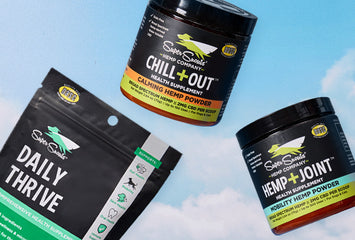
Super Snouts formulates G.I. Balance around that checklist, pairing named strains with prebiotic fiber in a powder that mixes into food rather than a pill you have to negotiate past a suspicious dog.
FAQ
Is plain yogurt a reasonable probiotic for a dog?
It is a mild one at best. Yogurt cultures get chosen for fermentation performance rather than gut colonization, live counts swing enormously between brands, and lactose bothers plenty of adult dogs. A tablespoon of plain unsweetened yogurt is harmless for most dogs and roughly a rounding error against a formulated product. Never use flavored or sweetened versions.
What if my dog already ate one of my probiotic capsules?
Check the ingredient panel immediately for xylitol, and if it appears, call your veterinarian or an animal poison control line right away. With a plain capsule containing no sweeteners, a single dose in an adult dog most often causes nothing worse than gas or one loose stool. Write down the time it happened.
Do dogs need to stay on a probiotic forever?
Most introduced strains are transient and stop being detectable within one to three weeks of the final dose. That argues either for continuous use if you want continuous effect, or for targeted use around specific disruptions such as travel, boarding, or a diet change. Neither approach is wrong; they answer different questions.
Can a probiotic be given alongside an antibiotic?
Generally yes, spaced roughly two hours from the antibiotic dose so the drug is not sitting directly on the culture. The prescribing veterinarian should confirm timing for the specific medication involved. Many clinics suggest continuing the probiotic for two to four weeks past the final antibiotic dose.
Does refrigeration actually matter?
It matters for some strains and not others. Modern spore-forming and freeze-dried preparations are engineered for shelf stability and hold their counts at room temperature. Older-style live cultures degrade noticeably in a warm cabinet. Follow the specific label, and never leave any probiotic in a hot car, which ruins either type.