

A dog supplement label has four parts worth your attention: the active ingredient list with amounts per serving, the inactive ingredient list, the guaranteed analysis, and the manufacturer's identity. Everything else is marketing. If a product will not tell you how many milligrams of each active ingredient are in one serving, you cannot evaluate it, compare it, or dose it — and that omission is usually deliberate.
Who regulates these products?
Less tightly than you would assume. Animal supplements occupy an unusual regulatory space in the United States: they are not drugs, and they are not quite feed either. Ingredient definitions come from AAFCO, state feed control officials handle much of the enforcement, and the result is inconsistent oversight across state lines.
The practical consequence is that the burden of verification lands on you. Some manufacturers participate in the National Animal Supplement Council's quality program and carry its seal, which indicates adverse event reporting and label auditing rather than proof that a product works. It is a floor, not a ceiling, and a floor is still worth having. The AAFCO consumer resources explain the ingredient definition side in plain language.
What does the active ingredient panel tell you?
Everything that matters about potency. Look for three things on each line:
- The specific ingredient name, ideally including form. "Zinc" tells you little; "zinc methionine" tells you which compound and hints at absorption.
- The amount per serving, in milligrams or grams, not per kilogram of product.
- The part used, for botanicals and mushrooms — root, leaf, fruiting body, mycelium. These differ substantially in composition.
If amounts appear per kilogram rather than per serving, you have arithmetic to do and the manufacturer knows it. That presentation is a choice.
What is a proprietary blend hiding?
Usually the ratio. A proprietary blend lists several ingredients under one combined weight, so you learn the total but not the split. A 500 mg blend of five ingredients might be 480 mg of the cheapest one and 5 mg each of the rest.
There are legitimate reasons a company protects a formula. There are also illegitimate ones, and you cannot tell them apart from the outside. Where a comparable product discloses full amounts, prefer it. Where nothing in the category discloses, at least know what you are accepting.
What does the guaranteed analysis actually mean?
It is a set of minimums and maximums, not exact values. Crude protein and crude fat are stated as minimums; fiber and moisture as maximums. The word "crude" refers to the laboratory method used to measure, not to quality.
This matters because a guaranteed analysis tells you the least you are getting, which is different from what is in the bag. Two products with identical panels can differ meaningfully in actual content. For supplements, the active ingredient list is the more informative document; the guaranteed analysis is closer to a compliance statement.
Which phrases should slow you down?
The last row is the one people skip. A lot number is how a recall reaches you. Its absence tells you something about the operation behind the product.
What can a label legally claim?
Structure and function, not disease. A supplement may describe supporting normal function or being a source of a nutrient. It may not claim to treat, cure, or prevent a condition — that language belongs to approved drugs and its presence on a supplement label indicates a company either unaware of the rules or unbothered by them.
This is genuinely useful as a screening tool. A panel that says "a source of beta-glucans" is describing composition, which is checkable. A package that promises to fix a named disease is making a claim it has no legal standing to make, and that tells you how much to trust the rest of the printing.
How do you compare two products fairly?
Work in cost per milligram of the ingredient you actually care about:
- Find the amount per serving of the target ingredient in each product.
- Find the servings per container for your dog's weight, not the smallest listed dog.
- Multiply to get total milligrams per container.
- Divide the price by that number.
- Compare, and expect the answer to surprise you.
A cheaper container is frequently more expensive per milligram. Doing this once for a product you already buy is a genuinely clarifying exercise.
What does a good panel look like in practice?
Specific and boring. Named ingredients, exact amounts per serving, the part used for anything botanical, a short inactive list you can pronounce, a manufacturer address, a lot number, and a best-by date.
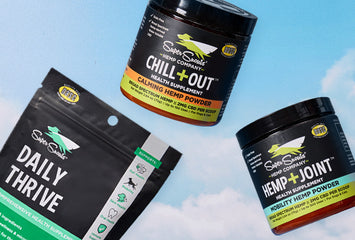
Super Shrooms is a reasonable example of the format to look for — named mushroom species, described as a source of beta-glucans, with the composition stated rather than implied. That is the standard to hold every product to, including ours. Our related pieces on stacking supplements without overlap and choosing a supplement format build on the same reading skills.
If a label leaves you unsure whether a product suits your dog, photograph the ingredient panel and send it to your clinic — most are happy to weigh in, and they will spot overlaps with existing medication that you would not.
FAQ
Does the ingredient order on a label mean anything?
For inactive ingredients, yes — they are listed by weight, heaviest first, so the first two or three make up most of the volume. Active ingredients are typically listed with explicit amounts instead, which makes order irrelevant there. If actives are listed without amounts and only in order, treat that as a disclosure gap.
Is the NASC seal worth looking for?
It is a useful signal but not a guarantee of efficacy. Membership requires adverse event reporting, label claim review, and quality system audits, which filters out the least careful operators. It does not mean the ingredient does what you hope, and plenty of good products from small manufacturers lack it.
What is the difference between mycelium and fruiting body on a mushroom label?
They are different parts of the organism with different compositions. Fruiting body is the mushroom itself; mycelium is the root-like network, often grown on grain that ends up in the finished powder. Beta-glucan content differs substantially between them, so a label that specifies which one it used is giving you real information.
Should I worry about inactive ingredients?
Scan them once. Most are harmless binders and flavorings, but this is where artificial colors, unnecessary sugars, and known individual allergens turn up. For a dog with a diagnosed protein sensitivity, the inactive list is the part that matters most, since flavoring is frequently animal-derived.
How do I check whether a company is reputable?
Look for a physical address, a phone number answered by a person, published certificates of analysis on request, and a clear recall history. Companies confident in their manufacturing generally make their testing available. Reluctance to share a certificate of analysis for a specific lot is informative in itself.