

Owners of a Miniature American Shepherd should focus supplement decisions on three documented realities: orthopedic screening concerns like hip dysplasia despite the breed's small size, the MDR1 gene mutation that changes how many of these dogs process certain drugs, and the digestive and nervous-system demands of a genuinely high-drive herding brain in a 30-pound body. Get those three right and you've covered most of what this breed actually needs.
Super Snouts here. We'd rather under-promise and let ingredients do the talking — so here's the evidence-first version of the MAS playbook.
A small dog with a big-dog engine
The Miniature American Shepherd — recognized by the AKC in 2015 and descended from small Australian Shepherds — stands 13–18 inches and typically weighs 20–40 pounds. Same merle-splashed coat, same watchful intelligence, same bottomless work ethic as its larger cousin, packaged for apartments and agility rings. Expect 12–13 years, per the American Kennel Club breed profile, and expect to spend most of them finding jobs for a dog that considers unemployment a personal insult.
That drive is the through-line of this whole guide. An MAS trains harder, jumps more, and stresses differently than the average small breed, and its supplement routine should reflect that.
The MDR1 conversation every MAS owner needs to have
Before we talk about any supplement, one genetic fact towers over the rest: a substantial share of Miniature American Shepherds carry a mutation in the MDR1 (ABCB1) gene, inherited from their Aussie ancestry. Affected dogs can't pump certain drugs out of the brain properly, which makes standard doses of some common medications — including certain parasite preventives, sedatives, and anti-diarrheals — potentially dangerous.
What this means in practice:
- Test your dog. A simple cheek-swab DNA test tells you the MDR1 status once, for life.
- Tell every vet who treats your dog, including emergency clinics, and note it on your dog's records.
- Never give leftover or over-the-counter medications — loperamide, notably — without your veterinarian's explicit okay.
This isn't a supplement issue; it's the reason the "ask your vet first" habit is non-negotiable in this breed. It's also a good filter for supplement brands: anyone selling herding-breed products without mentioning MDR1 hasn't done the reading.
Joints: why a 30-pound dog still needs an orthopedic plan
Small doesn't mean exempt. The Miniature American Shepherd's parent club and OFA statistics document hip dysplasia in the breed, and the sport-dog lifestyle most of these dogs lead — weave poles, dock diving, flyball, frisbee — adds repetitive load that pet dogs never see. Cornell's veterinary resources on canine hip dysplasia (Cornell Riney Canine Health Center) make the point that management is easiest when it starts before arthritis does.
Our approach for an active MAS:
- Screen and know. If your dog competes, hip evaluation gives you a baseline worth having.
- Support early. Green-lipped mussel — the single ingredient in Joint Power — supplies omega-3s, GAGs, and chondroitin from one whole-food source, and it scales down cleanly to small-dog doses.
- Warm up and surface-check. Two minutes of trotting before agility runs, traction on slick floors, ramps instead of repeated couch launches. Free, and worth more than most jars.
- Recheck annually. Your veterinarian should reassess gait and weight yearly; sport dogs hide soreness beautifully.
Fueling the herding gut
High-drive dogs run their digestion hot. Trial weekends, travel crates, schedule changes, and pure arousal all show up in the stool of a sensitive MAS, and plenty of owners know the pattern: perfect at home, pudding at the competition. Stress colitis is real, and it's boring to manage but easy to support.
What we keep in the gear bag:
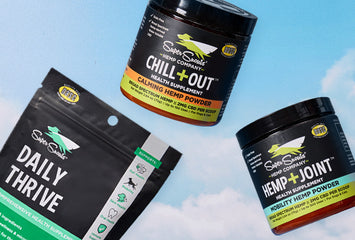
- Firm Up! — pumpkin and apple fiber for stool consistency, started a couple of days before travel rather than after the mess.
- G.I. Balance — probiotics plus botanicals for the dog whose stomach gurgles its way through every new environment.
Feed a consistent base diet, transition foods over a week or more, and treat any diarrhea lasting past 48 hours — or any episode with blood, vomiting, or lethargy — as a call-the-clinic event rather than a supplement opportunity. With MDR1 in the picture, resist the urge to medicate digestive upset yourself; that's precisely the scenario where this breed's genetics bite.
Minds that never idle: nervous-system support
An under-stimulated MAS invents work — herding children, spinning at fences, barking at photons. The first prescription is always behavioral: daily training, sniff walks, puzzle feeders, an actual job. Supplements come second, and we'd point you toward brain-supporting ingredients rather than sedation. Lion's mane mushroom has early but interesting research around nerve growth factor and cognition, which is why Lion's Roar is built around it — we think of it as support for the thinking dog, from young sport prospects to seniors starting to sundown. Genuine anxiety — storm phobia, separation distress, reactivity — warrants a veterinary or veterinary-behaviorist consult before any product, because behavior meds and MDR1 status need professional coordination.
Eye health rounds out the breed's documented list: progressive retinal atrophy and hereditary cataracts occur in the MAS, both screened by DNA test and ophthalmologist exams. No supplement changes those genetics — buy from breeders who test, and keep up annual eye checks.
Putting the routine together
A lean, well-screened Miniature American Shepherd routine might look like: green-lipped mussel every morning, lion's mane through heavy training seasons, pumpkin fiber starting two days before travel, and a probiotic blend during stressful stretches. Introduce each one solo, a week apart, at the low end of the weight-based dose — and clear the full lineup with your veterinarian, who should already have your dog's MDR1 result on file.
Quick answers for MAS owners
Does MDR1 status affect which supplements are safe?
The mutation mainly affects specific medications rather than food-based supplement ingredients, but it raises the stakes on professional oversight generally. Bring your dog's genetic result and complete supplement list to your veterinarian and let them screen for interactions — that habit will protect your dog for life.
Is a Miniature American Shepherd the same as a Mini Aussie?
Essentially, yes — the breed was developed from small Australian Shepherds and took the Miniature American Shepherd name with AKC recognition in 2015. Health-wise they share the Aussie's documented concerns, including MDR1, hip dysplasia, and inherited eye disease.
How early is too early for joint support in a sport prospect?
We'd wait until skeletal maturity — roughly 10–12 months in this size range — before daily joint supplementation, and keep puppy exercise low-impact until then. Your veterinarian can time it against growth-plate closure for your individual dog.
What helps competition-weekend diarrhea?
Consistency beats cures: same food, same feeding times, fiber support started before you leave, and decompression breaks between runs. If a weekend still ends in soft stool, pumpkin fiber typically restores things within a few days — and anything worse or longer belongs to your vet.
One last thought
The Miniature American Shepherd compresses a ranch dog's heart into a duffel-bag-sized frame, and it deserves care planned with the same seriousness you'd give the full-sized version. Know the MDR1 status, protect the joints that power all that flying, back up the gut before stress hits, and keep your veterinarian in the loop at every step. We'll keep making the single-ingredient tools; you bring the frisbee.
For education only — your veterinarian remains the right decision-maker for your dog's supplements, medications, and health plan.