

Most canine supplements need somewhere between two and twelve weeks before a change becomes visible, and the range depends almost entirely on what the ingredient does. Fiber shifts stool within a few days. Joint ingredients that rely on tissue turnover need two to three months. Skin and coat changes track the hair growth cycle, so eight weeks minimum. Anything promising results overnight deserves suspicion.
Why is the range so wide?
Because "working" means different biological events depending on the product. A supplement that acts inside the gut lumen never has to be absorbed at all; it does its job on the way through. One that alters cartilage composition has to be digested, absorbed, transported, and then incorporated into a tissue that replaces itself slowly.
The rate-limiting step is what sets the clock. For a fiber source, the limit is transit time — roughly a day. For a coat ingredient, the limit is how fast a hair follicle produces new shaft, and no amount of extra dose speeds that up. Understanding which category you are in prevents both premature quitting and pointless persistence.
What governs how fast an ingredient shows up?
Four variables account for most of the difference:
- Site of action. Ingredients working in the digestive tract act fastest. Ingredients working in bone, joint, or skin act slowest.
- Tissue turnover rate. Intestinal lining cells replace themselves every few days; cartilage takes months.
- Whether the body stores it. Water-soluble compounds reach steady state in days. Fat-soluble ones build up over weeks.
- The starting deficit. A dog with a genuine shortfall responds faster and more visibly than one who was already adequate.
That fourth point explains a lot of the variability owners report between two dogs in the same house on the same product.
What are realistic timelines by category?
These are median expectations, not guarantees. Individual dogs land outside them in both directions.
What does "working" actually look like?
Decide before you start, in writing. Vague impressions after six weeks are worthless because your own expectation contaminates them. Pick two or three things you can count:
- Stool score, using the same 1–7 chart every time, recorded daily.
- Stair behavior — does she take them one at a time or two? Count on a specific staircase.
- Scratching bouts in a fixed thirty-minute evening window.
- Weight, weekly, same scale.
- A photograph of the same patch of coat under the same lighting, every two weeks.
Photographs are underrated. Gradual change is nearly invisible day to day, and a side-by-side at week eight settles arguments that memory cannot.
Why do owners so often see results in three days?
Partly because some things genuinely are that fast, and partly because of how observation works. When you start a new product you also start watching more closely, which changes what you notice. Add regression to the mean — people begin supplements when things are at their worst, and worst points tend to improve on their own — and you get a strong impression of speed that the ingredient may not have earned.
This is not a reason to dismiss what you see. It is a reason to keep a written record so that at week ten you are comparing data rather than feelings.
Where does fiber sit on this spectrum?
At the fast end, and for a mechanical reason. Soluble fiber does not need absorption. It reaches the colon, absorbs water, gets fermented by resident bacteria into short-chain fatty acids, and alters the physical properties of what is passing through. All of that happens within one transit cycle, which for most dogs is under 24 hours.
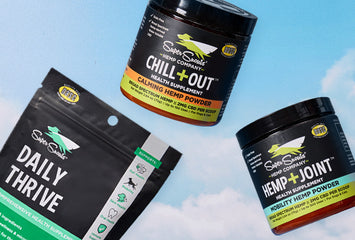
Pumpkin is a familiar source of soluble fiber, and Firm Up concentrates it into a powder, which is why the observable window for it is measured in days rather than months. If you want the mechanism in more depth, see our explainer on short-chain fatty acids in the canine colon.
How long should you commit before deciding?
Give any supplement the full duration of its category plus two weeks. Stopping a joint product at week five, then concluding it does nothing, is a common and expensive mistake — expensive because you have paid for the trial without collecting the result.
The opposite error costs more. Once several weeks have passed with no shift at all, the useful next move is a veterinary recheck rather than a bigger scoop. Persistent signs that do not respond to a reasonable nutritional trial usually mean the underlying situation is something diet was never going to address, and more product simply delays finding out. Knowing when supplements are not the answer matters as much as knowing when they are.
How do you run a trial that gives you a real answer?
Change one thing at a time. Start one product, hold food, treats, and exercise constant for the full window, and record your chosen markers. Introducing a supplement the same week you switch foods guarantees an uninterpretable result.
Set a calendar reminder for the end date so you actually evaluate rather than drifting into a permanent subscription. And if you stop, stop cleanly — a washout period of two to four weeks tells you whether the change reverses, which is the closest thing to proof available at home.
FAQ
Can I speed things up with a higher dose?
Rarely, and often not safely. For ingredients limited by tissue turnover, extra intake does nothing to the timeline because the bottleneck is biological rather than nutritional. For fat-soluble vitamins and minerals, higher doses carry genuine accumulation risk. Some products do specify a loading dose for the first few weeks; follow that instruction if it exists, and do not invent one if it does not.
Why did it work for my neighbor's dog in a week?
Starting condition explains most of it. A dog with a real shortfall in something shows a dramatic response, while a dog who was already sufficient shows almost nothing. Age, body size, gut transit speed, and concurrent medication all shift the curve too. Comparing timelines between dogs tends to produce more confusion than insight.
Should I see anything at all in the first week?
For gut-focused ingredients, yes — stool changes within a few days are expected. For everything else, no, and the absence of early change tells you nothing about the eventual result. Judging an omega-3 product at day five is like judging a haircut before it grows out.
Does it matter what time of day I give it?
Consistency matters more than the specific hour. Give it at the same point relative to meals each day so absorption conditions stay comparable, which also makes your trial data cleaner. Fat-soluble ingredients absorb better alongside a meal containing some fat.
How do I know a result is real and not coincidence?
Stop the product and watch. If the marker you tracked drifts back over two to four weeks, and then improves again when you restart, that is about as strong an answer as home observation can produce. Seasonal factors confound this for skin and coat, so run the test outside a shedding transition if you can.