
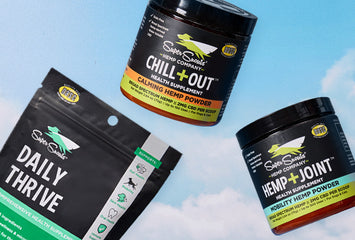

An Aussiedoodle owner's supplement strategy should serve the engine this cross actually runs on: an Australian Shepherd's athletic drive and a Poodle's quick mind, packaged with both parents' documented hip dysplasia risk and the Poodle side's touchy digestion. Because it's a mix, your dog may draw heavily from either parent — so this guide covers the likely bases and leaves the final calibration to you and your veterinarian.
The cross at a glance
Aussiedoodles blend Australian Shepherd and Poodle (standard or miniature), most commonly landing in the 25–70 pound range with a wavy-to-curly merle, blue, or tricolor coat. Both parents sit near the top of canine intelligence rankings, and the cross inherits the workload requirement that comes with that hardware: these dogs need daily physical exercise and mental employment, or they will freelance. Typical lifespan estimates run 12–15 years, longer for smaller individuals.
Herding instincts frequently come through — expect some ankle-awareness around running children — along with the Aussie's velcro attachment to its people.
Joints on a dog that never stops moving
Hip dysplasia is documented in Australian Shepherds and Poodles alike, and the Aussiedoodle's athletic lifestyle — fetch marathons, agility, dock diving, general parkour — loads those joints daily. That combination is why we'd rank structural support as this cross's top supplement lane.
The hierarchy of what helps: lean body condition above all (ask your veterinary team to score your dog and set a target — fluffy coats disguise weight gain shockingly well), muscle-building steady exercise second, and targeted nutrition third. For the nutrition piece, green-lipped mussel from New Zealand delivers a naturally combined package of omega-3s, chondroitin sulfate, and glycosaminoglycans — the single ingredient in Joint Power. One traceable input beats an ingredient list you need a magnifying glass to audit.
Growing puppies are a special case: hold off on joint products until your vet confirms skeletal maturity, and keep adolescent exercise varied rather than repetitively high-impact.
The Poodle stomach strikes again
Ask any doodle community about digestion and settle in — sensitive stomachs are a running theme, largely credited to the Poodle lineage. Aussiedoodles commonly show it as loose stool after diet changes, post-excitement digestive upset, or intolerance of rich treats.
Our playbook is short and unglamorous. Keep the diet consistent, and transition new foods across a week or more. Match treats to the dog — simple, single-protein options over rich novelties. Maintain a daily probiotic baseline so the microbiome has depth on its bench, and keep a pumpkin-fiber-plus-probiotic product ready for flare days: Firm Up! is ours, built around that exact pairing. When upset lasts beyond a couple of days or brings vomiting, blood, or a flat, low-energy dog, that's veterinary territory — VCA's guidance on GI upset draws the same line we do.
Larger, deep-chested Aussiedoodles also inherit enough Standard Poodle anatomy to justify basic bloat literacy: multiple smaller meals, no sprinting on a full stomach, and immediate emergency care for a swollen, retching, distressed dog.
Supporting the always-on nervous system
Here's the part many Aussiedoodle owners come looking for: the brain. Two working-breed intellects in one dog produce a nervous system that runs hot — quick to learn, quick to overstimulate, occasionally anxious when under-employed or left alone. The first prescription isn't a supplement at all; it's a job. Trick training, scent games, herding balls, puzzle feeders, and structured settle-time do more for an Aussiedoodle's equilibrium than anything in a jar.
For nutritional backup, we look to lion's mane, a mushroom studied for its role in supporting normal cognitive and nervous system function — the anchor of our Lion's Roar blend. It's support for a healthy brain, not a sedative and not a fix for separation distress. True anxiety — destruction when alone, panic at noises, inability to settle despite adequate exercise — deserves a veterinary or veterinary-behaviorist consult before any product experimentation. Bring your vet the full picture; they can distinguish under-stimulation from clinical anxiety, and the plans differ completely.
One genetic footnote worth knowing: some Australian Shepherd lines carry the MDR1 mutation affecting drug metabolism. A cheap DNA test tells you if your Aussiedoodle carries it — information your veterinarian will want on file before prescribing certain common medications.
The Aussiedoodle daily framework
- Work: 60+ minutes of exercise plus genuine brain work, every day, non-negotiable.
- Joints: green-lipped mussel from maturity onward; hands-on weight checks monthly.
- Gut: consistent diet, probiotic baseline, Firm Up! for episodes.
- Mind: enrichment first, lion's mane as nutritional support, professional help for true anxiety.
- Admin: MDR1 test results and every supplement choice shared with your vet.
Questions Aussiedoodle owners ask
Are Aussiedoodles hyper?
They're working-bred, which reads as hyper when under-exercised. A fulfilled Aussiedoodle is focused and trainable; a bored one redecorates. Meet the workload before assuming a temperament problem, and ask your vet to rule out medical causes if restlessness seems extreme.
What helps an Aussiedoodle's sensitive stomach?
Consistency, slow transitions, modest treats, and daily probiotic support cover most cases. Pumpkin fiber shortens the loose-stool episodes that slip through. Chronic or severe signs need diagnostics, not more toppers.
Do Aussiedoodles need calming supplements?
Only after enrichment and exercise are genuinely handled — most "anxiety" in this cross is unspent capability. For dogs with real, persistent stress, loop in your veterinarian; nutritional nervous-system support like lion's mane can complement, but never replace, a proper behavior plan.
How big will an Aussiedoodle get?
Anywhere from 25 pounds (mini Poodle parent) to 70 (standard parent) — ask about both parents' sizes for your best estimate. Size also determines bloat-awareness relevance and joint-support timing, so it's worth pinning down early with your vet.
Wrapping up
The Aussiedoodle is a brilliant athlete wearing a teddy-bear costume, and its supplement plan should honor all three facts: guard the joints that power the athleticism, steady the Poodle-issue stomach, and feed the remarkable brain while giving it real work. Audit the whole routine with your veterinarian annually — smart dogs deserve smart owners with smart backup.