
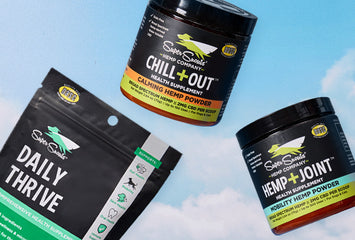

The American Staffordshire Terrier's supplement priorities read straight off its veterinary chart: skin allergies sit at the top of the breed's documented issues, joint support matters for a compact frame carrying serious muscle, and a dependable gut routine keeps everything else on track. AmStaffs are famously game for whatever you ask of them — the owner's job is making sure skin and skeleton can keep up with that heart.
The AmStaff at a glance
Standing 17 to 19 inches and weighing 40 to 70 pounds, the American Staffordshire Terrier packs remarkable strength into a medium frame. The AKC characterizes the breed as confident, good-natured, and devoted — a people-oriented dog whose courage is matched by an almost embarrassing affection for its family. The stiff, glossy coat comes in nearly every color, sheds moderately, and hides nothing: every scratch, hive, and bald patch shows. Life expectancy runs 12 to 16 years, generous for a dog this muscular, provided the itch and the joints are managed well.
The number-one topic: why is my AmStaff so itchy?
Ask any veterinary dermatologist which breeds fill their waiting room and Staffordshire-type dogs make the list. Environmental allergy (atopic dermatitis), flea-bite sensitivity, and food-responsive skin disease all appear in the breed at above-average rates, typically showing up as paw-licking, armpit and groin redness, recurrent ear flare-ups, or hives after grass time. VCA's atopic dermatitis overview explains why itch tends to worsen year over year without intervention — which is our argument for getting a veterinary diagnosis early rather than rotating shampoos for three summers.
Once your vet owns the treatment plan, the support layer is where we work. Functional mushrooms bring beta-glucan polysaccharides studied for immune modulation — relevant because allergic skin is an immune system running hot. Super Shrooms blends seven organic species into one powder; the single-ingredient alternative, Turkey Tail, suits dogs mid-elimination-trial where every variable counts. We'll never tell you a mushroom treats atopy — it doesn't — but supporting balanced immune function while your vet controls the itch is a sensible division of labor. Round it out with relentless flea prevention (one bite can light up an allergic dog for weeks) and a rinse-off after high-pollen romps.
Joint care for a muscle-dense frame
Hip dysplasia and cranial cruciate ligament injury both appear in the AmStaff's documented health picture, and the breed's explosive play style — hard launches, sharp turns, full-commitment fetch — loads exactly the structures at risk. VCA's arthritis primer makes the point we repeat constantly: joint disease is progressive, so the cheap interventions all live early in the timeline.
For this breed we'd do three things. Keep body condition athletic-lean — muscle is fine, padding is not, and the difference under an AmStaff's tight coat is easy to feel with flat hands over the ribs. Build warm-ups into high-intensity play instead of going zero-to-launch in the yard. And feed cartilage daily from early adulthood: green-lipped mussel — the only thing in our Joint Power — delivers omega-3s, glycosaminoglycans, and chondroitin in one whole-food ingredient. A sudden toe-touching lameness on a back leg, though, is a same-week vet visit; cruciate tears are orthopedic injuries, not supplement projects, and your veterinarian will tell you where your dog stands.
Worth a line for completeness: responsible AmStaff breeders screen for cerebellar ataxia (NCL-A), an inherited neurologic condition with a reliable DNA test. If you're buying a puppy, ask for the parents' results; if you're unsure of your dog's background, your vet can arrange testing. Genetics questions belong in the exam room, and the Cornell Riney Canine Health Center offers solid plain-language background reading.
The everyday gut program
AmStaff stomachs are generally robust — what unsettles them is usually lifestyle: high treat volume during training, enthusiastic scavenging, or abrupt diet switches. Two products cover nearly every scenario we hear about. Firm Up! is the stool normalizer — pumpkin and apple pectin restoring consistency after the training-treat bender or the mystery mulch snack. G.I. Balance is the daily driver for dogs running gassy or gurgly, pairing probiotics with settling botanicals. Feed twice daily on a schedule, switch foods over a week or more, and treat a food-motivated breed's sudden appetite loss as the meaningful signal it is — vet, same day.
Our AmStaff routine, assembled
- Daily from ~18 months: Joint Power, dosed to weight — insurance for hips and knees that play hard.
- Allergy season (or continuous for atopic dogs): Super Shrooms alongside the veterinary itch plan; flea prevention without gaps.
- In the cupboard: Firm Up! for stool wobbles; G.I. Balance promoted to daily if gas is a lifestyle.
- Annually: wellness exam covering skin review, gait check, and weight — the three dials this breed lives and dies by.
Introduce one product per week so you can attribute changes honestly, and bring the lineup to your vet — label doses are population averages, and your dog is a sample size of one.
AmStaff FAQ
What helps an American Staffordshire Terrier with seasonal allergies?
Start with a veterinary diagnosis — modern allergy treatments are dramatically better than the guess-and-hope era. Around that plan, layer flea prevention, post-outdoor rinses, and immune-supportive mushroom polysaccharides. The combination controls itch far better than any single piece.
Should AmStaffs take joint supplements before they show stiffness?
We think so, for this breed. The play style loads hips and knees hard, and cartilage support compounds over years the way stiffness-rescue never can. Start after growth plates close — your vet can confirm timing around 18 months.
Is a raw or grain-free diet the answer to my dog's skin problems?
Not automatically, and sometimes not at all — food is the culprit in only a minority of itchy dogs. A properly run elimination diet trial, supervised by your veterinarian, is the only reliable way to implicate food. Switching bags at random mostly delays the real answer.
How much exercise does an AmStaff need to protect its joints?
Consistency beats intensity: 45 to 60 minutes daily of walks, structured play, and training beats a sedentary week capped by a two-hour weekend explosion. Warm into fetch gradually and keep hard stops on grass rather than pavement where you can.
Are probiotics worth it for a dog with a strong stomach?
For a genuinely trouble-free gut, save your money — that's our honest answer. Promote probiotics to daily use when there's a pattern worth addressing: chronic gas, gurgling, or stool that never quite stays firm. Your vet can rule out diet causes first.
Final word
An AmStaff will match your energy for a dozen years and change — the least an owner can do is quiet the itch, protect the landing gear, and keep the fuel line steady. Diagnose skin properly, feed the joints before they complain, keep the gut program simple, and let your veterinarian referee every addition. That's the whole playbook, and this breed rewards every page of it.